ARTICLE OVERVIEW
What do I cut first when I run out of time? From September to June I am more or less permanently at war with the clock, and what gets cut is never the thing with a deadline attached: it is the unmeasured part of the day, the part that produces nothing anyone could check. I reread Momo this summer, years after first meeting it at the age my own students are now, and found a novel about a whole city making that same cut, and about what it costs them. It goes to my own students this year. What follows is how I am teaching it with sixth and seventh graders, and my notes on the question.
A novel your students will not have heard of
Michael Ende published Momo in Germany in 1973, and it won the German Youth Literature Award the following year. It came six years before The Neverending Story, the novel behind the 1984 movie, which for most English-speaking readers is the only place his name has ever appeared. Momo itself has had a quieter life in English: a 1974 translation by J. Maxwell Brownjohn, published in Britain as The Grey Gentlemen, and a 2013 translation by Lucas Zwirner for McSweeney’s McMullens, with drawings by Marcel Dzama. If you are ordering copies, the Zwirner is the one in print; the character names below follow Brownjohn, whose text is the one widely quoted in English.
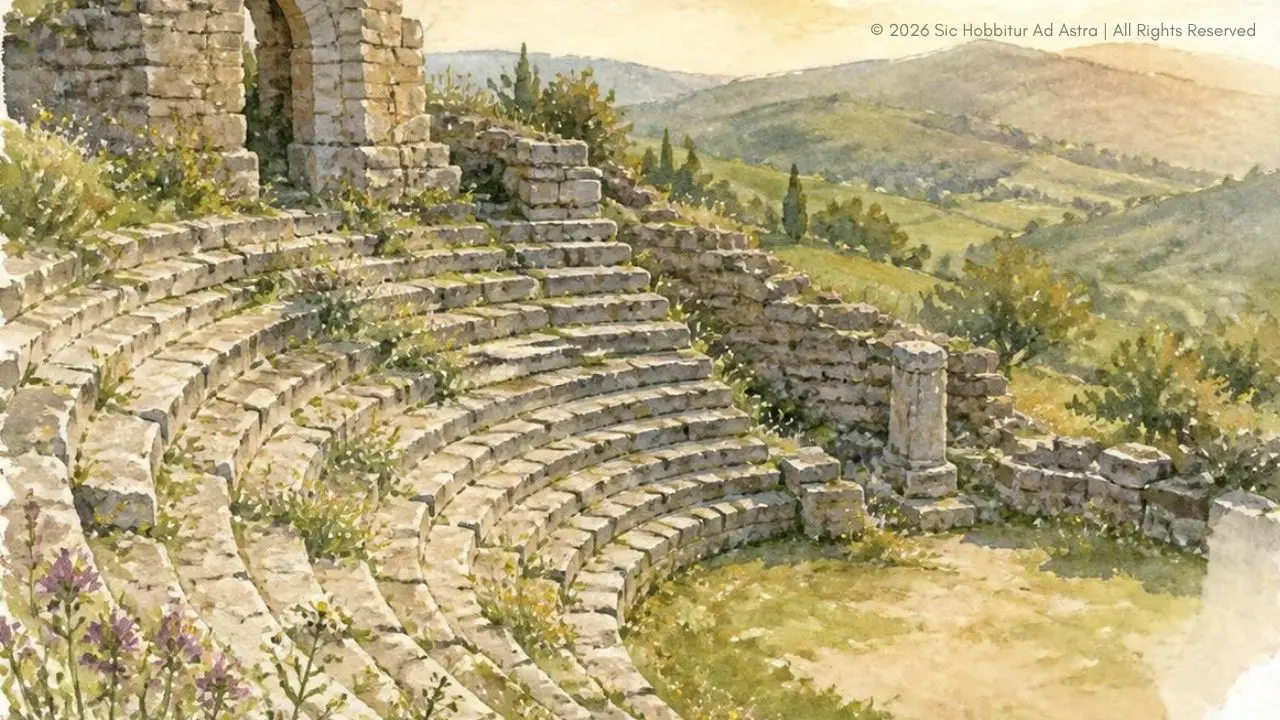
The story opens on the outskirts of a city, in the ruins of an amphitheater, where a ragged child of unknown age and unknown family takes up residence and the neighborhood adopts her. Her closest friends are Beppo, an old street sweeper, and Guido, a young tour guide who invents stories for anyone who will listen. Then the men in gray arrive, agents of the Timesaving Bank, and explain to the adults of the city that the hours spent on what cannot be counted can be saved instead, deposited, and returned later with interest. The city speeds up. But the saved time is never returned.
What makes the book teachable is not that plot. It is what the novel can put in front of a class all at once: what listening does to the person being listened to; what it means for time to be given rather than counted, first of all for the joy and the self-knowledge of whoever gives it; and what counting produces instead, which is sadness, hurry, and a life sliding out of your hands. And none of it speaks only to the children. It speaks to me, and I suspect to you, reading this with next week already mapped out.
The only thing she was rich in
Momo owns nothing. No family, no schooling, no shoes to speak of. What the novel says of her, early on, is that time was the one thing she was rich in.
And what she does with that time is play, of course, but mainly listen. People thought slow and dull, says the narrator, find intelligent ideas arriving, and not because Momo has said or asked anything that leads them there; she sits still, her large dark eyes on the speaker, attending with real interest, and the person feels thoughts surfacing that he never suspected he possessed. The worried and the indecisive know their own minds from one moment to the next; the shy feel suddenly at ease; the downhearted, hopeful. And anyone who believes his life a failure, himself one among millions of people as replaceable as broken windowpanes, comes and pours out his heart to her — and even as he speaks he realizes, by some mysterious means, “that there was only one person like himself in the whole world, and that, consequently, he mattered to the world in his own particular way” (ch. 2, “Listening”).
Rereading that passage, I felt something lurch. I thought of my students, and of a couple of friends in a hard stretch, and of how much I would like to be that for them: someone who can give a person back the knowledge of their own beauty and uniqueness. I thought too of a teacher who once listened to me that way, which is to say really listened. What the passage left in me was an urgency about authenticity.
That is why the book is going into twelve-year-olds’ hands this year. They are asked to listen all day long, by me among others, and are almost never shown what listening consists of or what it produces; here it is an action a character performs, with consequences on the page that a student can point to. And it is exactly this that the rest of the novel sets out to destroy.
Discussion Ideas for Your Classroom
- Momo is the poorest character in the book and the novel calls her rich. Rich in what, and what does she spend it on?
- Follow the people who come to her, in the order the text gives them. Why is the man who believes himself replaceable placed last?
- The man arrives convinced he does not matter and leaves convinced he does, and Momo has said nothing. What happened?
- Where in your own week does someone listen to you like that? What is it for?
What saving time costs
The men in gray set about that destruction, and their instrument is arithmetic. In the chapter that is the single most teachable stretch of the book, a barber, Mr. Figaro, is converted. An agent of the Timesaving Bank arrives, asks him his age, and begins writing figures on the shop mirror: his forty-two years turned into seconds, then the hour a day given to his deaf and arthritic mother, the quarter hour to his budgerigar, the half hour to Miss Daria, the quarter of an hour each night spent sitting at the window thinking over the day. Line by line the sums are totalled, and the total is his whole life, down to zero. Then comes the offer: time deposited in the Bank doubles every five years.
The barber is not threatened, hypnotized, or deceived about any fact. He is argued into it, and every figure on the mirror is correct.
The detail I do not intend to let a class miss comes afterwards. As the chalk figures fade, Mr. Figaro forgets the agent and forgets the visit. What stays with him is the resolution to save time, which he now takes for his own idea.
Then the novel shows the city living by that arithmetic, and this is where it becomes harder than a fable. Saving time turns into a form of servitude. Counting and calculating every second does not open up space; it drains the color out of what is left.
People stop coming to Momo, where they had gone to hear themselves. Guido, for his part, goes on telling stories and is famous for them, which is not the same as being happy: bent to the same logic of calculation, the stories lose their wings. They become something to be consumed, nearer to the worst hour of television than to anything he used to make up in the amphitheater, and he ends as the servant of the work that had been his joy. He is rich now, and his riches are the kind that destroy a person who cannot share them; Momo, who owns nothing but her time, spends all of it on other people.
What the city has given up, in both cases, is the same: hours that produced nothing anyone could count, and that were the only hours in which people came to know themselves and one another.
And it closes in on the amphitheater, one friend at a time. The children who used to invent games in the ruin are put away in depots built for them, so that they learn something useful instead of wasting the afternoon, and above all because their parents have no afternoon to spend on them. Nino, who keeps the little tavern, turns his poor old regulars out of it to give the place tone and get the business moving. The fear underneath all of it is the same: that an hour might pass with nothing to show for it.
We live under a version of that same demand: that whatever we do should be for something — growth, a skill, a line on an application, a goal nameable at an interview. It reaches even the hours we used to spend on nothing in particular, and a hobby is now expected to turn into a second income. It is the air my students breathe all day, and I breathe it with them.
The children in the novel are the first to pay for it. An afternoon that has to produce something is an afternoon in which nobody is simply watching them. That is the chapter I find least comfortable to teach, and the one I would least want smoothed over, because it raises a question I keep turning over and have not settled: how much of that is true, concretely, of the families in front of us.
Discussion Ideas for Your Classroom
- Reconstruct the gray man’s argument in order. What is he asking the barber to accept before the numbers begin?
- Which of the barber’s hours are counted as wasted? Who decided that, and on what grounds?
- The arithmetic is not wrong. Where, then, does the argument fail?
- Mr. Figaro forgets the visit but keeps the resolution, and believes he thought of it himself. Why would the men in gray want it that way?
- Guido gets what he wanted from his storytelling, and the storytelling stops being worth anything. What changed about the stories, and who changed it?
- The city gains hours and loses color. What does the novel mean by that, and what would it look like in a week of your own life?
How the writing makes you feel the hurry
There is a reason to teach the novel rather than only talk about what is in it, and it is a matter of craft: Ende can put hurry on the page. The reader does not merely learn that the characters are rushed; the prose produces the anxiety, and you feel it while you read.
The clearest case is the chapter in which Momo finally finds Guido again, long after he has become famous. He is delighted to see her. He seizes her, swings her into the air, kisses her, dances with her in the middle of the road — and then talks. Where has she been. Did she find his letter. Did she eat at Nino’s. How is old Beppo. How are the children. Do you remember how it used to be. He asks everything and leaves room for nothing, and the narrator says it without comment: she had tried several times to answer, and since the torrent never broke, she gave up and watched him instead. He is beautifully dressed and smells of cologne, and she feels him a stranger.
Around them the scene is built out of interruptions. Three managers have come in the car, one of them with an eye on her wristwatch, because there is a plane. Each exchange is cut off by the next demand, and when Guido finally asks for five minutes alone with his friend he is asking his own employees for permission. He gets them, and fills them talking. Then he is taken away.
In the whole encounter, Momo does not say one word: a scene about a girl whose single gift is listening, written so that there is nothing for her to listen into.
For a classroom this is a gift. The effect is strong enough that students register it without being prompted, and the question of how it was produced has a findable answer on the page. Ask them what it feels like to read, then send them back to work out what the sentences are doing to make it feel that way.
Discussion Ideas for Your Classroom
- Read the reunion aloud, one student as Guido. What does it feel like, and where on the page does the feeling start?
- Find the sentences that create the sense of hurry and describe what they do: length, punctuation, interruptions, what gets repeated.
- He wants to stay and cannot. What makes that worse than if he simply did not care?
- Rewrite a short passage so that it feels calm. What did you have to change?
Who the men in gray actually are
Two late revelations change the whole book, and they are worth holding in view from the start.
The first concerns what the men in gray are made of. They are a nothing — an emptiness that exists only because human beings allow it to. They do not descend on the city from outside; they are kept in being by the people they feed on. This matters for the kind of story a reader thinks he is in. A villain with a power of his own can be fought, or fled, or lost to. A villain who exists on sufferance is a different problem, because the question stops being how to defeat him and becomes what exactly we are supplying.
Readers with any Augustine behind them will recognize the shape of it. Evil, in the Enchiridion, is not a thing: it is the absence of a good that ought to be there, the way cold is not a substance but the lack of heat. Ende is not writing theology and I would not claim he is, but the structure is the same one, and it gives a young reader something sturdier than a fable about bad men in hats. The men in gray are what is left where attention used to be.
The second revelation concerns the limit of their power. They cannot stop time being given to human beings, and they cannot reduce the amount that arrives. What they can do is poison it. The distinction is worth slowing down over, because it contradicts the way the whole city, and most of us, describe the problem. Nobody in that city has less time than before. They have exactly as much, spoiled — and spoiled time still passes, hour for hour, while feeling like nothing at all. The complaint students will have heard all their lives, and will make themselves, is that there is not enough; the novel answers that the quantity was never the question.
Those two facts together are what keeps the book from being a lament, and what makes it bearable to teach. The damage is real, it is ours, and it is in principle reversible, since what we sustain we can stop sustaining. That is a harder thing to say than either despair or reassurance, and children are perfectly able to hear it.
Discussion Ideas for Your Classroom
- The men in gray are described as a nothing that people allow to exist. What does that mean, and how does it change the way you read what they do earlier?
- They cannot take time away or make less of it, only poison it. What is the difference between losing time and having it poisoned?
- If they depend on us, what exactly is it that we give them?
Practical notes
The prose is plain, the chapters are short, and the fantasy is gentle; vocabulary will not be the obstacle. I am reading the whole novel with my students, and a good deal of it aloud: several chapters stand well enough on their own to be taken in a single sitting.
If the whole novel cannot have a place in your year, three chapters carry most of what I have described here: Momo’s listening, in the second chapter; the barber and the Timesaving Bank; and the reunion with Guido. They can be read aloud in a week and discussed with nothing else assigned.
Last Thoughts
What stayed with me longest is not the argument about time but the pages on what Momo’s listening does to the person in front of her. She has no advice to give and gives none. She attends, and people walk away restored to themselves.
That is not a lesson plan. It is a standard, and an uncomfortable one, because it is available every day and costs nothing except the thing I am always short of. The novel does not tell me to stop planning the year. It makes the planning answerable to a question I would rather face in October than in June: what am I spending the hour for?
Happy teaching,
Chiara
Related Reading
A Band, on the First Day of School — starting sixth grade with School of Rock, for anyone building the first weeks of the year.
What Makes a Character Relatable — why some characters stay with students and others do not, across eight books I teach. Momo belongs on that list.
The Teacher I Want to Become: Why I Show My Students Les Choristes — a film about what happens to children when one adult pays attention to them.