ARTICLE OVERVIEW
What happens to a story when you take one word out of it? Christopher Nolan’s The Odyssey gives us the Cyclops, the cave, the burning stake, and the escape beneath the rams, but not the name Odysseus gives the giant. This article is about that missing name. I go back to the Greek of Book 9 to show what that single word is doing: how it hides Odysseus’s cunning inside the language itself, and how it opens an arc that ends in Poseidon’s curse. Then I share how I bring a pun that exists only in Greek to students who will never read a line of it. You will find the story told in full, a lesson you can run in a single class period, discussion questions, and several ways to carry the idea into other activities.
A Missing Word
When I wrote about Nolan’s Odyssey this summer, the missing “Nobody” trick took up a single line in a long list of departures from Homer. I would like to return to that line today and give it the space it deserves, because the film keeps almost everything around the trick — the cave, the blinding, the escape beneath the rams, an Odysseus who is plainly clever — and leaves out only the moment when his cleverness becomes a word.
That omission is a departure from the text, and on that point there is nothing to debate: the Odyssey has the name, and the film does not. What can be debated is what the cut implies, and whether we find the exchange worth making. So in these pages I want to ask what it would mean to read the Odyssey without that word: what kind of hero, and what kind of story, we would be left with. And if you show Nolan’s film in class, the question offers a natural place to pause, go back to the text with students, and talk through what the screen has chosen to leave behind.
The Trick, Told in Full
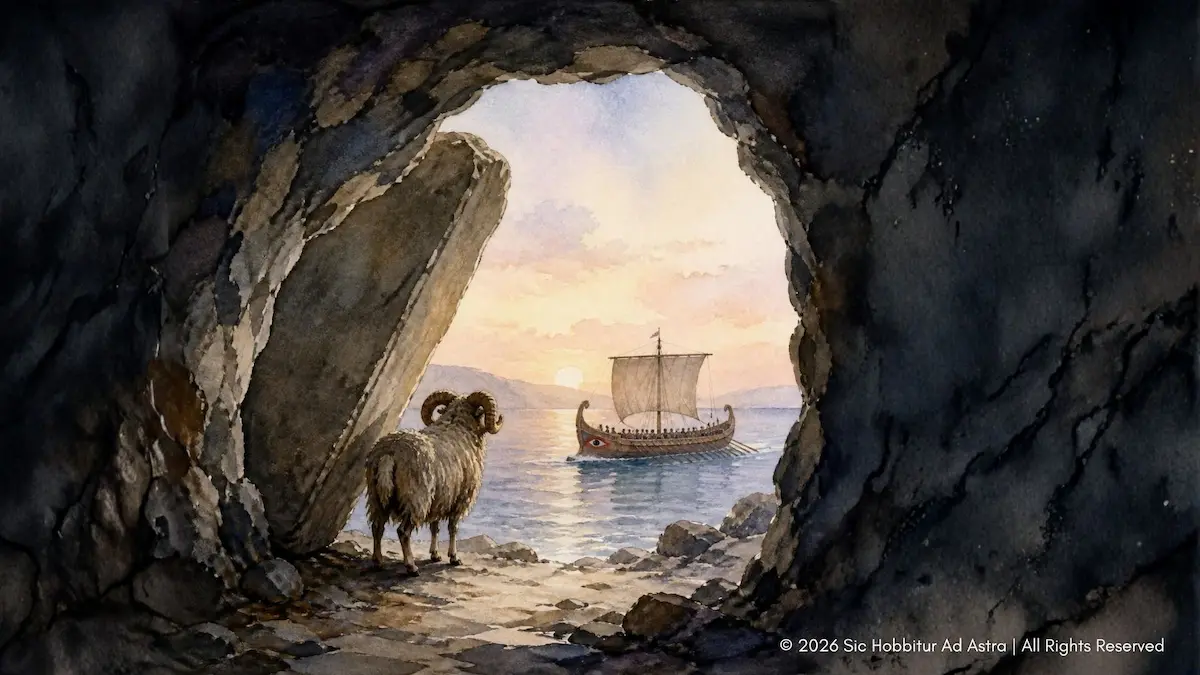
Odysseus chooses twelve of his best men and walks with them into a cave on the island of the Cyclopes, hoping for the gifts a host owes his guests. (The whole episode runs from 9.193 to 9.414; below, I give line numbers only for the passages I quote.) The cave belongs to Polyphemus, a son of Poseidon, a one-eyed giant who keeps sheep and goats. When he comes home with his flock, he seals the entrance with a boulder that no number of men could move. Odysseus appeals to him in the name of Zeus, protector of guests; Polyphemus answers that the Cyclopes care nothing for Zeus. Then he seizes two of the Greeks and eats them for supper, two more in the morning, and two more that evening.
Odysseus cannot kill him in his sleep, because then they would all die in a sealed cave. So he plans. He has his men sharpen a length of olive wood and harden it in the fire. Then he offers Polyphemus a strong, dark wine the giant has never tasted. Polyphemus drinks, asks for more, and asks his guest’s name, promising a guest-gift in return; in all, he drains three bowls. Odysseus answers:
Oûtis emoí g’ ónoma — “Nobody is my name. Nobody is what my mother and father call me, and all my companions.”
Odyssey 9.366–367
The giant’s gift is a cruel parody of hospitality: he will eat Nobody last. He falls asleep, drunk, and Odysseus and his men drive the burning stake into his single eye.
Polyphemus’s scream brings the other Cyclopes running from their caves, and they call to him through the stone (9.405–406): ē mē tís seu mēla brotōn aékontos elaúnei? ē mē tís s’ autòn kteínei dólōi ēè bíēphin? — “Surely no mortal is driving off your flocks against your will? Surely no one is killing you, by trickery or by force?” And Polyphemus, from inside, gives the only answer he can (9.408): Oûtís me kteínei — “Nobody is killing me, by trickery or by force.” If nobody is hurting him, the neighbors reason, his pain must come from Zeus, and there is nothing to do but pray to his father, Poseidon. So they go home, and Odysseus’s heart laughs within him at how his name and his flawless cunning had fooled them (9.413–414).
Three Words in One
This is the passage I bring to class, because three different things are happening in it at once, and only one of them survives in English.
Oûtis. Greek has two words for “not.” The first, ou, denies a fact: ou tis, “not anyone,” “no one.” Pressed into a single word and given the sound of a name, ou tis becomes Outis, Nobody. So when Polyphemus cries Oûtís me kteínei, he means a name, and his neighbors hear a fact: no one is killing me. This layer survives translation. In English, “Nobody is killing me” misleads the other Cyclopes exactly as it does in Greek.
Mē tis. The second word for “not,” mē, belongs to what is not a plain statement of fact: wishes, fears, and questions of a particular kind. When a Greek speaker asks a question that hopes for the answer “no” — the way we say in English “Surely no one is…?” — the negative has to be mē. That is the form of the neighbors’ question we have just read: mē tís seu mēla… elaúnei? mē tís s’ autòn kteínei? — “Surely no one is driving off your flocks? Surely no one is killing you?” So the name Odysseus built out of ou tis never appears in their mouths. The grammar of their own question makes them say mē tis instead.
Mētis. And mē tis, spoken aloud, sounds almost exactly like mētis: cunning, practical intelligence, the craft of the mind. Odysseus is the man of mētis. One of his most frequent epithets is polýmētis, “of many counsels,” and when he laughs at the end of the scene, the word he uses is exactly this one: mētis amýmōn, “flawless cunning” (9.414).
So the trick works twice. Polyphemus speaks a name, and his neighbors hear “no one.” The neighbors ask whether anyone is hurting him, and in asking, they say something that sounds like the name of the thing that is hurting him. Both times, the weapon is hidden in the words, and no one in the scene hears it.
What Translation Keeps, and What It Loses
Only the first of those three layers reaches our students in English, and that loss has a name in my own language. Italians have a proverb for it: traduttore, traditore — “translator, traitor.” The two words sit so close in Italian because tradurre, to translate, comes from Latin traducere, “to carry across,” while tradire, to betray, comes from tradere, “to hand over.” English keeps the second verb in two words of its own. From tradere come both tradition, what is handed down, and traitor, the one who hands someone over. Every translation stands somewhere between the two: it hands the poem on, and in handing it on, it gives some of it away.
The Cyclops scene shows both movements at once. What is handed on is the first layer, which English translators keep in different ways: Robert Fagles and Richmond Lattimore give us “Nobody,” while Robert Fitzgerald chose “Noman.” None of them can keep the second and third layers, because English has no pair of words that sound alike and mean “no one” and “cunning.” Something is lost in every version our students hold in their hands. Nolan himself ran into the same wall: when Jon Stewart brought up the missing wordplay on The Daily Show, he answered simply, “It’s a pun. Puns in translation are tough. I tried” (as reported by SlashFilm).
It is worth telling students so, plainly. A translation keeps a great deal and cannot keep everything, and a student who knows that the Greek hides mētis inside a question reads the scene with a second pair of eyes, even in English.
If your students have met Athena’s birth, there is one more thread to pull. Mētis is also a goddess, Athena’s mother, whom Zeus swallowed, so that the goddess of wisdom was born, in the most common version of the myth, from the head of the god who had taken cunning inside himself. Odysseus’s special patron is, fittingly, the daughter of Cunning.
What the Cut Costs
Reading the Odyssey without the name would mean losing more than a pun. The trick is only half of an arc, and the other half comes a hundred lines later.
Safe on his ship, pulling away from the shore, Odysseus cannot stay Nobody. Against his men’s pleading, he shouts back at the blind giant (9.502–505): if anyone ever asks who blinded you, tell them it was Odysseus, sacker of cities, son of Laertes, whose home is on Ithaca. The little word tis returns in his taunt, “if anyone asks,” but now Odysseus is the one who wants to be asked about. He gives his name, his father, and his home: everything a person needs to be found.
And Polyphemus uses all of it. He remembers an old prophecy that a man named Odysseus would take his sight, and now he knows who that man is. He prays to his father, and his curse repeats, almost word for word, what Odysseus has just shouted (9.528–535): let Odysseus, sacker of cities, son of Laertes, whose home is on Ithaca, never reach home. Or, if he must, let him come late and in misery, having lost all his companions, on someone else’s ship, and find trouble in his house. Poseidon hears him, and the rest of the poem is the answer to that prayer.
As Nobody, Odysseus escapes; as Odysseus, he is cursed. A curse needs a name to land on, and he supplies it. In the cave, his cunning worked by making himself no one; once he is free, what he cannot bear is to remain no one.
In Nolan’s film, Odysseus neither hides behind a false name nor shouts his true one: once out of the cave, he shoots the blinded Cyclops with an arrow, and the giant’s pursuit costs him more of his men. Polyphemus still prays to Poseidon, but his curse no longer falls on a name Odysseus has handed him. Whatever else the film does well, and I have written that it does a great deal (on teaching Nolan’s The Odyssey in the classroom), that arc is not one it can offer. The poem does, and for a class that has seen the film, bringing it back to the surface opens a conversation worth having.
Bringing It Into the Classroom
I use a single class period for this, and it works best after students have read Book 9 once, in translation, on their own.
- Reread the scene aloud, without comment. From the question about the name to the neighbors walking away, 9.353–414. Let students hear the trick land as it lands on the Cyclopes.
- Put three words on the board. Outis, mē tis, mētis, transliterated, with the Greek letters beside them if your students enjoy the look of the alphabet. Say them aloud. I don’t explain anything yet; I ask what they notice. Usually, after a moment, someone hears the echo.
- Explain the two Greek words for “not,” as briefly as possible: ou for statements of fact, mē for what is wished, feared, commanded, or supposed, including questions that expect the answer “no.” The point is not the grammar. The point is that the neighbors, by the form of their own question, say something that sounds like mētis without knowing it.
- Go to the ship. Read 9.502–505 and the curse in 9.528–535 side by side, and ask students to underline what the two passages share.
- Close with the question of the name. The discussion questions below are the ones I would choose from.
For middle school, I stop at Outis and mētis and spend the time on the arc of the name: Nobody who escapes, Odysseus who is cursed. For high school, the grammar of ou and mē and the problem of translation are worth the extra ten minutes.
Discussion Ideas for Your Classroom
- Odysseus escapes because the Cyclopes cannot hear the trick hidden in their own words. What does the scene suggest about the relationship between cleverness and language?
- Why does Odysseus shout his real name from the ship, when silence would have kept him safe? What does he gain, and what does it cost?
- Polyphemus’s curse repeats Odysseus’s words almost exactly. Why might the poem want us to notice that repetition?
- Our English translations keep “Nobody” but lose mētis. Does knowing what was lost change how you read the scene? What else might a translation be unable to carry?
- Nolan’s film keeps the blinding and the escape but not the name. What kind of Odysseus comes out of the cave without it? Would you have made the same choice?
Taking It Further
Two threads run through this lesson, the intelligence that lives in words and the weight of a name, and both carry well beyond Book 9.
A translation workshop. Give students the Cyclopes’ exchange in a plain literal version and ask them to find an English solution that keeps more of the wordplay than the published translations do. They are unlikely to solve it, and that is the lesson: they will understand from the inside what translators give up and why.
Cleverness that lives in words. The Greeks had one word, mētis, for an intelligence that is at once practical and verbal: the craft of finding a way out, very often by finding the right words. In the cave, Odysseus’s sharpest weapon is a sentence. Ask students to go looking for other moments when a command of language shows a sharp mind at work, in literature and well beyond it. The range can be as wide as they like: a slogan that sells a product in four words, a closing argument that turns a jury, a riddle, a joke that lands at exactly the right moment, a line of poetry that says in a few syllables what a whole essay could not. Each example should come with a few sentences on what the words are doing, and why it took intelligence to choose them. Then turn the question around, as Book 9 does: when has a word spoken too soon undone a clever plan?
A creative writing task. Ask students to write a short scene in which a character escapes by a trick that works only in words: a double meaning, a misheard name, a question that answers itself. It is the same craft of misdirection I discuss in my article on mystery writing activities for middle school, on the scale of a single word.
Names that mean something. The Odyssey is full of names with stories in them, starting with the hero’s own. In Book 19, his grandfather Autolycus names the baby Odysseus after his own anger at many men, from the verb odýssomai(19.406–409). Students can build a small dossier of names that tell a story, in the poem and in their own lives. This pairs naturally with the word-of-the-day habit I describe in my piece on teaching Greek etymology in class.
Riddling with a monster. If you have read The Hobbit with your class, an interesting parallel opens here: in the novel, Bilbo refuses to tell Smaug his name and answers in riddling titles instead. One of them, Barrel-rider, lets the dragon work out that the men of Lake-town helped the dwarves, and Lake-town pays for it. Setting Bilbo beside Odysseus makes a strong comparative writing task: two small heroes, two monsters, two names withheld, and a slip that costs someone else dearly. (If the novel is not yet part of your year, I have written about the educational value of The Hobbit for middle school.)
Last Thoughts
A pun in a language our students don’t read is easy to pass over, on the screen and on the page alike, since our English translations let most of it slip away without a trace. Yet in that one small word, Book 9 holds both Odysseus’s genius and his undoing. I think of this passage the way I think of the first word of the Iliad, mēnis (I wrote about it in teaching the Iliad with the proem): a small place where much of the poem can be seen at once.
And there is something in it for us, too. Much of what we do happens in words, and most of it is small: the question we put to a student, the name we remember or forget in the first week of school. We work in the same material as Odysseus in that cave, and we are not exempt from its consequences.
Warmly,
Chiara
Related Reading
- Teaching Greek mythology in middle school: the pillar this piece hangs from, and where the questions behind the myths begin.
- Percy Jackson mythology activities: where Athena’s birth from Metis first appears on the blog.
- Circe by Madeline Miller for high school: the other side of Odysseus’s voyage, told by one of the women he met.