ARTICLE OVERVIEW
Is there a film you can show in class when a group of students needs to breathe again — one that reminds them, and you, what a classroom is for? That’s the question I want to answer here. For me the film is Les Choristes, and it’s the movie I reach for when I want my middle schoolers to remember what a teacher and a class can be. Here’s when I show it, and why.
There’s a question I suspect a lot of us carry into the classroom on a hard week: can a movie actually help a class remember what it is here for? I think one can, and for me it’s always the same film — Les Choristes, my favorite movie, as it happens. This is my case for showing it.
The question reaches me from the other direction too. At least once every cycle, a student looks up and asks me why I decided to become a teacher. It’s an enormous question, and every time it comes, it sends me back to my own story — my choices, my desires, the long road that brought me here. This isn’t the place to explain all of that (if you’re curious, you’ll find a little more on my Meet the Teacher page), but the short version has everything to do with the kind of deep relationship you see in Les Choristes. So when that student asks, I try to give a real answer, in steps: I tell some of my story, sometimes I write a little down and share it, and when the occasion allows, I propose that we watch the film together.
Les Choristes — The Chorus, in English — is a 2004 French film directed by Christophe Barratier. If you haven’t seen it, it’s worth setting aside an evening for.
The Story and the People in It
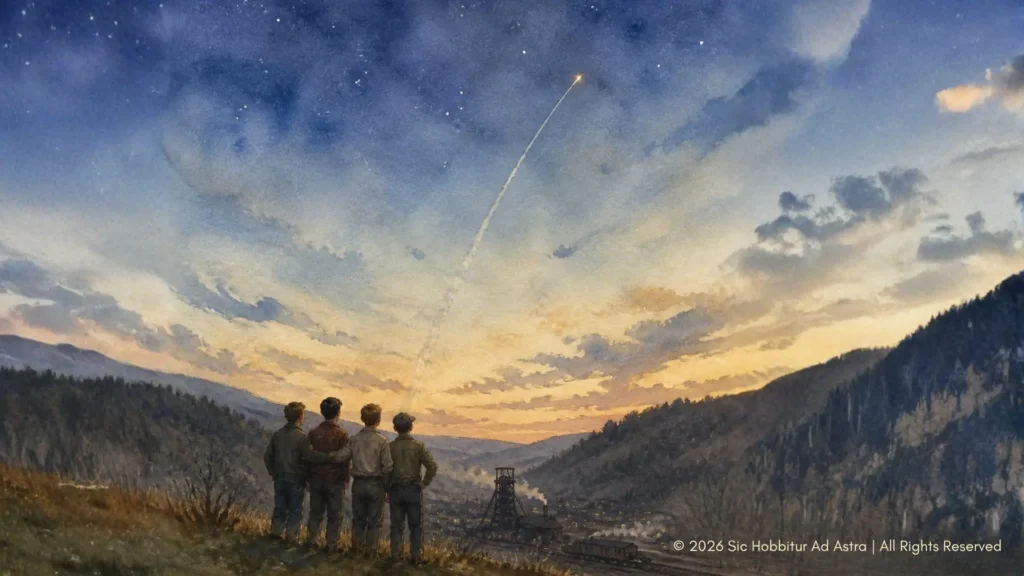
The film opens in the present day. Pierre Morhange, a world-famous orchestra conductor, learns of his mother’s death and returns to France. An old classmate, Pépinot, appears at his door with a diary that once belonged to a teacher they shared as boys. They begin to read it together, and the film settles back into 1949.
That year, Clément Mathieu — a music teacher out of work, a musician whose own career never took flight — arrives to take a job as a supervisor at a bleak boarding school for difficult boys. The place is called Fond de l’Étang, “the bottom of the pond,” and the name tells you most of what you need to know. The headmaster, Rachin, runs it on a single principle: action, reaction. A boy commits a fault; a boy is punished, without mercy.
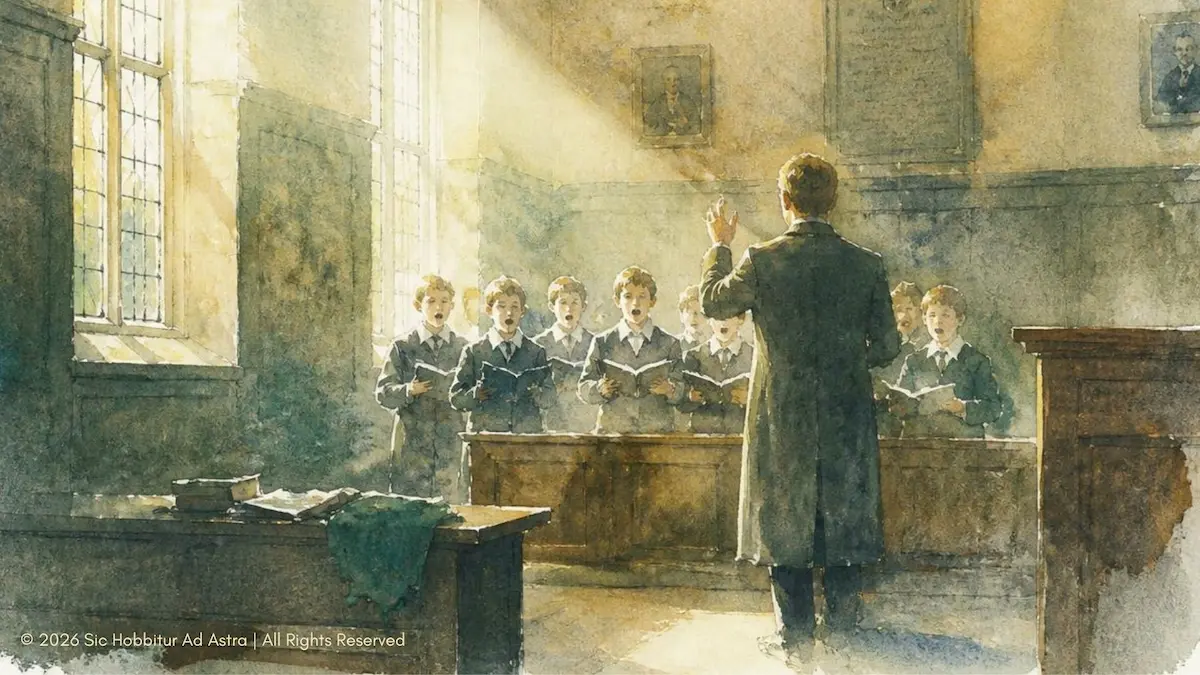
Into this Mathieu brings something the school has never tried. He begins, quietly, to teach the boys to sing. He listens to each voice, finds where it belongs, and builds a choir out of children everyone else had given up on. Among them is Pierre Morhange — sullen, watchful, and gifted with a voice of startling purity. And at the edges, always, is little Pépinot, the youngest, orphaned but certain that his father is coming to fetch him on Saturday.
I won’t spell out the ending. I’ll only say that it holds a departure that feels like defeat and is not, and a quiet act of fatherhood that arrives from a direction no one was watching. The music that carries all of this — “Vois sur ton chemin” above all — is the work of Bruno Coulais, and it is, to my ear, some of the most beautiful film music ever written.
So here, in short, is what the film offers a class. It gives students a teacher figure who is genuinely good, and shows them — without a lesson attached — what an education and a bond between students and teachers can be. It is gentle enough for middle school and true enough for any age, and it carries real weight about empathy, talent, and the worth of the children everyone else overlooks. It asks nothing but attention, and it tends to give a tired room its air back. The rest of this article is why I believe that, and when I put it on.
What I Love About It
I love this film because it holds the whole of life in it, told with purity but never made saccharine. The greatness of talent is here, and the beauty of what a human being is and can do — and, in the same frame, the pettiness a person can sink to. There is the pain of failure: a man who wanted to be a musician and finds himself a school supervisor. And there is real redemption, the kind that happens in silence, unannounced.
There is a promise of love that never quite comes true, and a fatherhood that flowers in the most unexpected soil. There is the great desire for life running headlong into orphanhood, poverty, cruelty. There is growth. And then there is the music — music so beautiful I imagine it is what they have in paradise. For me, everything I need to find my way back to real life is somewhere in this film.
Why the Film Reaches Students
I keep a short list of the reasons I return to it with a class:
- A teacher who is a genuinely good figure — humane, patient, on the students’ side.
- Real weight given to the desire for a large life.
- Real weight given to the small ones, the children off in a corner, like Pépinot.
- Music that is simply beautiful — and beauty draws us in. I first saw this movie at thirteen, and it was the music, more than anything, that cast the spell. No film since has ever taken hold of my heart in quite the same way.
- A true, appealing picture of what a class can be, what a bond between students and teachers can be, what an education can be.
When to Show Les Choristes in Class
I reach for this film in a few kinds of moments. When we need a pause. When the class needs to recover a sense of itself as a place where good things happen, where real talents surface, where there are good people. When the relationship with teachers has grown tired and needs air. Honestly, at almost any moment. I recommend it especially for middle school, but it is beautiful and true at any age.
Last Thoughts
So, to answer the question I began with — the student’s, and my own. When someone asks me why I became a teacher, this is more or less what I say: I did it because I would like to learn to be like Clément Mathieu. To give students the thing I love most — music, for him; literature, in my case — and to cheer for them wildly, for their road and their choices, even when those choices wound me. To let them meet the good that I was lucky enough to meet myself, because someone once showed it to me.
I think this film does a great deal of good for the relationship between teachers and students, because it helps us look at one another truthfully. We teachers rediscover the vertiginous task we carry — how much difference we can make in the life of a young person. And students meet a beautiful figure of a teacher, with the chance that some curiosity, some trust in us, might be rekindled in them.
And beyond all that, something very old remains true: good begets good. This is a story with a great deal of good inside it — which is, in the end, why I keep showing it.
Happy teaching,
— Chiara
Related Reading
If Les Choristes speaks to you, you may also like two other films where a teacher or guide changes a group of young people from the inside: my thoughts on School of Rock and on Remember the Titans. For everything else I’ve written about bringing movies into an ELA classroom, see the Movies in the Classroom category.