Article Overview
What does it take to turn a group of students who happen to share a room into something that resembles a team? I don’t have a method for it, but I have a film I return to — and an activity that grows out of it. Here’s the thinking behind why I show my students Remember the Titans, and what I’ve learned about the slow, unglamorous work of building a class that can hold together.
A Reflection-Based Approach to Help Students Become a Team
As you surely know, every September we teachers inherit a room full of strangers.
They may have known each other for years — some of them since elementary school — but knowing a name is not the same as seeing a person. There are the ones who sit together by habit, the ones who stay at the edges, the labels that arrive before the students do. I stand at the front knowing that whatever I hope to teach them this year will also pass through the quality of what is, or isn’t, between them.
This is the part of teaching no lesson plan quite prepares you for. A class can read well, write well, and still not know how to be together. Trust, attention to one another, the willingness to be surprised by a classmate — these take time, and they don’t arrive on their own.
Over the years I’ve learned to let a story do what I can’t do by asking. Put the question directly — are we a team? — and a class goes quiet, or gives you the answer it thinks you’re after. Put a film in front of them and they’ll tell you the truth about themselves while they think they’re only talking about someone else. Remember the Titans is the one I keep coming back to, when I realize the class in front of me is one that needs to get to know itself.
A Story About Being Put Together
At its center, Remember the Titans is a story about people who did not choose each other.
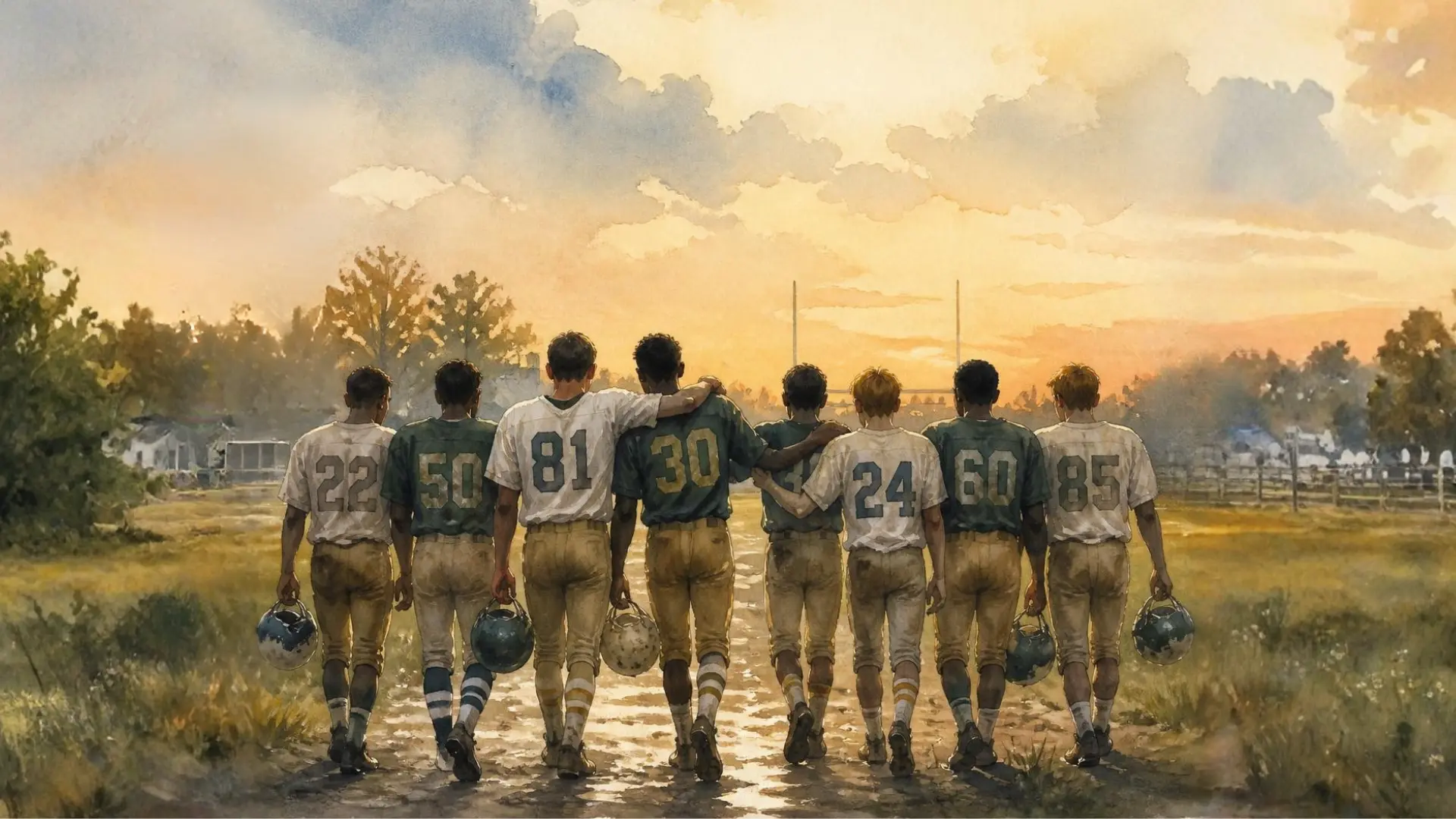
Set in Virginia in the early 1970s, the film follows a high school football team as its schools desegregate and Black and white players are made to train, room, and play as one. They begin divided — by fear, by inheritance, by the assumptions each carries about the other — and much of the film sits in the discomfort of that beginning rather than rushing past it. What changes them is not a speech. It is proximity: being placed in situations that force them to listen, to depend on one another, to test what they thought they knew.
The friendship between Gerry Bertier and Julius Campbell is where I ask students to look most closely. The two don’t warm to each other because someone asks them to. They change because they are put in each other’s way long enough to stop performing and start speaking plainly.
I find that dynamic sits very close to what happens in a classroom. Students share a room every day and remain strangers to one another. They carry labels — assigned or chosen — that keep genuine contact from ever quite happening. The film gives us a story to think through all of this at a safe distance.
From Watching to Encounter
When I use the film, I try to move students past discussing community toward briefly practicing it. What I’ve settled into is a simple progression: a stretch of quiet, personal reflection; then a paired conversation with someone they wouldn’t have picked; then a return to the whole group to make sense of it together.
Of the three, the middle step is the one that does the real work — and the one I lifted most directly from the film. Coach Boone pairs players who would never have chosen each other and makes them learn something true about the other person before anything else can happen. So I pair students who don’t usually work together, and the task I give them is small: the real work is listening. Most of the growth I see happens in the ones who came in certain they already knew who their partner was.
The quiet beforehand and the sharing afterward are what keep that middle step from feeling like an exercise. The reflection lets a student arrive at the conversation having already thought honestly; the closing discussion lets the class name what happened, and ask why I bothered to have them do it at all. That last question is worth leaving with them.
If it helps to see the shape of it, here is the classroom community building activity in three steps:
- Personal reflection. After the film, students think quietly about what they saw and about their own class — where conflict comes from, what makes change possible, whether they are yet a team.
- Paired encounter. I pair students who don’t usually work together and give them guided questions about hopes and fears and the lives they imagine, with listening as the whole point.
- Whole-class discussion. The group comes back together to make meaning of it — what they learned about a classmate, and why the activity was worth doing.
What I’m Actually Hoping For
I won’t claim a single activity remakes a class. It doesn’t, and I’m wary of any lesson that promises it does.
What an afternoon like this can do is smaller and, I think, more honest: it interrupts the ordinary sorting of a classroom long enough for two students to see each other as more than a seating assignment. Sometimes that holds. Sometimes it fades by the next week and I try again with different pairs. The point isn’t a transformation I can measure by Friday. It’s that I keep making the room a place where being seen is possible.
And, I think, this is true of us as teachers too. We inherit our colleagues the way students inherit their classmates — already sorted, already labeled, some of us at the edges. We are not exempt from the work we ask of them. The film is about a team learning to become one; I’ve never been able to watch it without thinking that we are on a team as well, and that it, too, has to be built.
A Quick Note for Busy Teachers
If the progression above is useful to you, I’ve put together a ready-to-use reflection resource that follows it step for step — the quiet reflection, the paired questions, the closing discussion — for when you want to focus on the connection and not on building the scaffolding from scratch.
You can find it here:
More than the resource, though, I hope the idea is what stays with you, and that you adapt it to the particular room you walk into. Every class, like every team, arrives with its own story.
Warmly,
Chiara
Related Reading
If this is the kind of film you find yourself reaching for, two others in the same spirit:
- Another film about a group that slowly becomes a community — Dewey Finn’s unlikely band, and what it means for a teacher to see potential before students see it in themselves.
- The teacher I want to become, and why I show my students Les Choristes — a quieter film about a man who reaches a difficult group by refusing to give up on them.
You’ll find both, and everything else in this vein, under Movies in the Classroom.