Article Overview
Where does a dream come from, and what does it take to keep one alive? October Sky follows a coal-town boy who decides, against every reasonable expectation, to build rockets — and it’s the film I reach for at the start of the year, when I want students thinking about their own ambitions and the patient, unglamorous work of chasing one. Here’s how I use it to open that conversation.
Most of my students already know what they’re supposed to become.
Not in so many words, but they’ve absorbed it — from family, from where they live, from the quiet arithmetic of what people like them are expected to do. Part of what I want the start of the year to do is loosen that certainty just enough for a real question to get in: what would you attempt, if the future weren’t already written for you? In opening that question, I’ve always found a reliable ally in October Sky.
The film (1999, directed by Joe Johnston) tells the story of a boy who asks it and then, improbably, acts on it. I show it in the first weeks of school because it puts ambition on the table honestly — not as a slogan, but as something that begins small, costs a great deal, and rarely survives without help.
The Story
Based on Homer Hickam’s memoir Rocket Boys, October Sky takes place in the coal-mining town of Coalwood, West Virginia, in the late 1950s. Homer is a boy with a future already written for him: like nearly every boy in Coalwood, he is expected to go down into the mine his father runs, and that is the end of the imagining.
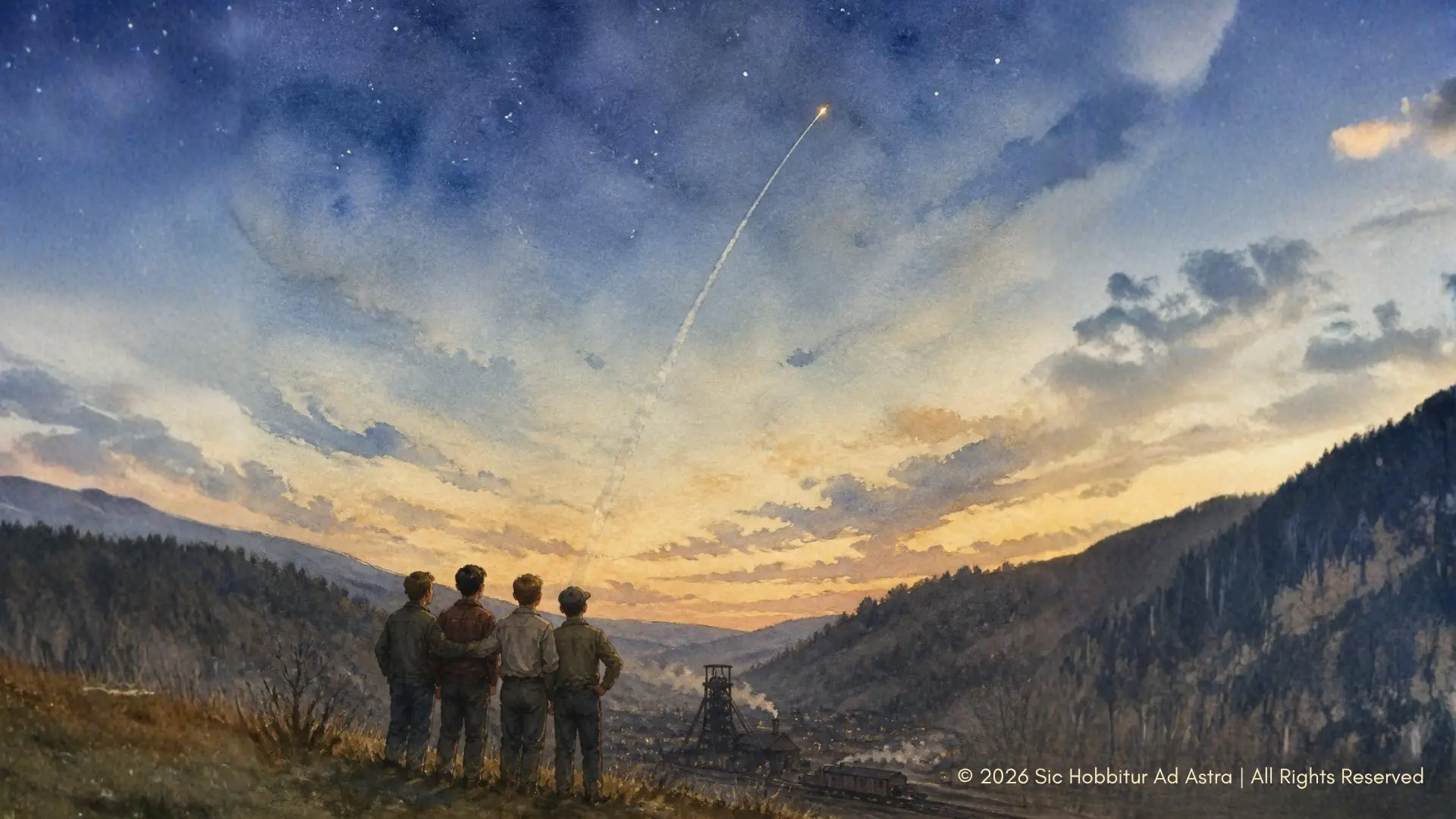
Then, on an October night in 1957, he watches Sputnik cross the sky — and something opens. He decides, against every reasonable expectation, that he is going to build rockets. What follows is a story of failed launches and singed eyebrows, of a town’s ridicule and a father’s hard disappointment, and of a handful of friends who build the impossible thing alongside him. It leads, eventually, to the national science fair — but the film is far less interested in the trophy than in what it costs, and who it takes, to get there.
I should say, too, that it’s simply a pleasure to watch. For all its serious themes, October Sky is warm and often funny, carried by characters you’re glad to spend two hours with — Homer above all, an easy kid to root for, decent and dogged without ever being a saint. Students settle into it quickly!
Where a Dream Begins
What I find most useful about October Sky is that it takes the origin of a dream seriously — the moment before anyone believes in it, including the dreamer.
Homer’s ambition doesn’t arrive fully formed or fearless. It starts as a light crossing the sky and a small, almost embarrassing thought: maybe I could do that. The film lets that thought be fragile, which is honest, because that’s how ambitions actually start in my students — not as declarations but as half-formed wishes they’re not sure they’re allowed to have. Watching Homer take his seriously, before he has any evidence it will work, gives students permission to take their own that seriously too. That permission is the first thing I want the film to offer.
And it insists on something students rarely hear said plainly: that a dream is a thing you choose, and keep choosing. Homer isn’t special in the way of effortless prodigies. He’s special in that he decides, and then decides again after every failure.
The Long, Failing Work of It
The other reason I trust this film is that it refuses to make achievement look fast.
The rockets fail — repeatedly, sometimes spectacularly, sometimes right in front of the people already sure the whole thing is foolish. And the film doesn’t rush past the failures toward the triumph; the failures are the story. In a moment when students are surrounded by images of success that seems to arrive overnight and without cost, a film that treats patient, repeated failure as the ordinary texture of achievement is quietly countercultural — a truer preparation for the school year than any pep talk.
The setback I keep coming back to with students is the one that almost sinks everything. A stray rocket goes missing, the boys are blamed for a forest fire, and clearing their name falls to Homer and a page of math he has to teach himself. His first calculation sends them to a spot where the rocket isn’t. He has to go back, factor in the wind he’d left out, and only then does the proof hold. Even the vindication arrives by way of a wrong answer corrected — which is, I tell my students, what learning something hard actually feels like from the inside.
No One Does It Alone
There’s a reason Homer succeeds, and the film never pretends it’s talent alone. It’s the people who refused to let his ambition die — and there are two kinds of them.
The first are his friends. Homer doesn’t build the rockets by himself; he builds them with a small band of boys who sign on to the impossible idea and stay through every failure — the steady one, the funny one, the brilliant misfit the others might never have chosen. The film gives their friendship real weight: the dream becomes something they carry together, and the shared work of it — the arguments, the salvaged parts, the launches watched side by side — is as much the point as the rockets. It’s worth naming for students, who often imagine ambition as a lonely, solitary thing. Homer’s isn’t. It has company.
The second is his science teacher, Miss Riley. She hands him the book with the math he needs, tells him plainly he’s capable of more than Coalwood will ask of him, and stands up for the boys when it costs her something. She doesn’t promise it will work. She simply refuses to accept the smallness of the future he’s been handed — and because a trusted adult refuses it, Homer becomes able to refuse it too.
And then, slowly, the circle widens past the people who believed from the start. Homer’s father, John — a mine superintendent who wanted his son underground beside him, and who spends most of the film unable to see the point of any of it — comes round only at the end, and hard-won lateness is exactly what makes the moment land. It’s to his father that Homer says the line the whole film has been building toward: “I may not be the best, but I come to believe that I got it in me to be somebody in this world” — and the reconciliation matters as much as the science fair. By then the whole town has begun to follow the launches too: the same Coalwood that laughed has started to look up. A dream, the film quietly argues, is rarely kept alive by the dreamer alone; it needs friends who build alongside you, one person who sees it early and says yes, that — go, and sometimes, eventually, even those who doubted it longest.
I draw this out with students on purpose, because it reframes what a mentor is: not someone who hands you your dream, but someone who believes in the one you already have until you can believe in it yourself. I ask them to think about who those people might be for them — the friends, the Miss Rileys, and the ones who might yet come around — and, just as usefully, how to become someone worth that kind of belief.
What Students Take Into the Year
Put together, that’s what I want October Sky to open in the first weeks: your ambitions are worth taking seriously, they’ll ask more patience and more failure than anyone advertises, and you were never meant to carry them alone. And there’s a quieter message in it for me. Every year a room fills with students who have a Sputnik-sized idea they haven’t dared say out loud — and the film reminds me that whether it survives may depend, in part, on whether someone in the room says yes, that — go. Often that someone is us.
A Resource to Help You Begin
If you’d like to open the year around the film, I’ve built a set of classroom activities designed to help students name their own ambitions and think about the work of pursuing them — individual and group tasks that invite them to reflect on a goal they care about, the place of learning in reaching it, and the people who might help them grow. Use them in class or set them as homework to prime a fuller conversation.
You can find it here:
And I’d love to hear from you: which film do you reach for at the start of the year? Tell me in the comments.
Warmly,
Chiara
Related Reading
If you like opening the year with a film, two others in the same spirit:
- A band, on the first day of school — School of Rock, and a classroom that becomes more than the sum of its students.
- Building classroom community with Remember the Titans — a reflection activity for turning a group of strangers into a team.
You’ll find more under Movies in the Classroom.