ARTICLE OVERVIEW
Written last but set first, The Magician’s Nephew poses a question every teacher of Narnia has to answer: do you start students with the book Lewis wrote first, or with the one that comes first in the story? This article lays out what each choice gives and what it costs—and shows how the decision is really a small version of a much larger question about how we come to know anything: whether we begin in wonder and move toward understanding, or begin with understanding and build toward wonder.
Written last, set first
When students first meet The Magician’s Nephew—and begin exploring the themes of The Magician’s Nephew—one detail tends to surprise them: although it is now printed as Book One of the Chronicles of Narnia, it was not the first written. The Lion, the Witch and the Wardrobe came five years earlier, and its own themes still shape the moral and symbolic structure of the whole series. Only afterwards did Lewis return to Narnia’s beginnings and write the story of its creation.
That small paradox—written later, set earlier—is more than a piece of trivia. It opens a real conversation about how stories are built, how readers come to know a world, and, quite practically, about the order in which a class should read the books.
Publication Order or Chronological Order?
Many editions now print The Magician’s Nephew as Book One, and chronologically that is where it belongs: it tells of the creation of Narnia, the origin of the White Witch, the first tree, and the lamp-post that will still be standing when Lucy arrives generations later. Reading in this order gives students the ground under the story before the story begins.
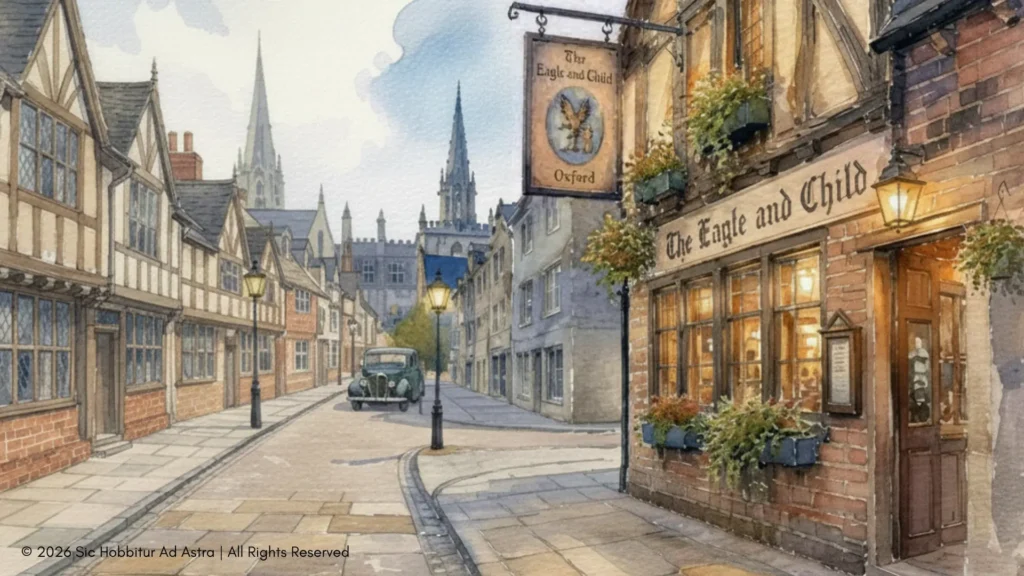
Beginning with The Lion, the Witch and the Wardrobe gives them something different: the experience of discovery. Students meet Narnia as Lucy does—through the back of a wardrobe, with no explanation, the snow and the lamp-post arriving out of nowhere. The mystery is intact. They do not yet know why a lamp-post burns in a forest, and the not-knowing is part of what they feel.
There is no single right answer, and that is what makes the choice worth putting to students rather than settling for them. What a teacher is really choosing between is two ways of coming to know a world:
- Do I want students to meet Narnia with wonder first, and reach understanding later—or to begin with understanding, and let the wonder deepen as the pieces connect?
- Is this their first encounter with fantasy of this kind, where surprise is part of the gift?
- Am I teaching the whole series, or a single novel that needs to stand on its own?
It is worth noticing that this is not only a question about Narnia. It is the same question the novels themselves keep asking—whether the world is best received as a gift that arrives unexplained, or grasped and mapped in advance. That thread runs through the whole of The Magician’s Nephew, where receiving the world rather than seizing it turns out to organize the entire book—as I show in the pillar article on the novel’s themes.
The Book Beneath the Others
Whichever order you choose, The Magician’s Nephew works as the foundation the rest of the series rests on. Here is the birth of Narnia in Aslan’s song, the arrival of Jadis out of the ruins of Charn, the moral testing of Digory in the walled garden, and the planting of the tree that will one day guard Narnia—and here, too, are the origins of the images students will have met, or will meet, in The Lion, the Witch and the Wardrobe: the lamp-post, the wardrobe’s wood, the long shadow of the White Witch.
Digory’s choice in the garden matters most of all. In resisting the temptation to seize the apple rather than receive it, he sets down one of the ethical patterns the whole of Narnia is built on—a moment that also opens naturally onto comparison with the creation and testing stories of the Bible, which I take up in an article on The Magician’s Nephew and the Bible. The Magician’s Nephew does not merely come before the other books in time. It gives the series its moral grammar.
Teaching the “Written Later, Set First” Structure
This is also a rare chance to show middle schoolers something about how literature is made—that a story can be returned to, deepened, and extended, and that what looks like a seamless world was in fact built in layers over years. Students who have read both books can trace an image back to its origin: the lamp-post that is simply there in Wardrobe has, in The Magician’s Nephew, a moment of planting. What felt mysterious turns out to have been intended all along.
A simple activity makes the point better than any explanation. Draw a two-column chart: on the left, elements introduced in The Lion, the Witch and the Wardrobe—the lamp-post, the wardrobe, the Witch’s power; on the right, their origins as revealed in The Magician’s Nephew. Filling it in, students discover for themselves that reading across the two novels turns mystery into design, and passive reading into something closer to detective work. It is a small exercise, but it teaches inference, intertextual attention, and the idea that a story is crafted rather than merely found.
Final Thoughts: Mystery or Origin?
The debate has no losing side, which is part of what makes it worth having. To begin with The Lion, the Witch and the Wardrobe is to begin in wonder and read toward understanding; to begin with The Magician’s Nephew is to begin with the foundations and read toward awe. Either way, the creation story stands as the ground the rest of Narnia is built on—written later, set first, and essential in whichever order a class comes to it.
With curiosity and encouragement for your teaching journey,
Chiara
Bring These Ideas Into Your Classroom!
If you’d like to explore the themes, order, and moral foundations of Narnia with your students, my TPT bundles for both novels include introductory sections on narrative order, chapter-by-chapter exploration, and classroom activities connected to the discussions in this article:
- The Magician’s Nephew MEGA Bundle — close-reading activities, puzzles, tests, and materials to guide students through each chapter.
- The Lion, the Witch and the Wardrobe MEGA Bundle — activities, discussion prompts, and comprehension guides for the novel.