ARTICLE OVERVIEW
Why teach The Hobbit in middle school? Not mainly for the vocabulary or the adventure, real as those are, but for what the book quietly does: Tolkien takes the least likely creature in his world and lets him discover that the courage, loyalty, and goodness he needed were in him all along. This article makes the case that we teach this novel as a story of revelation rather than transformation—and that it tells young readers the one thing every teacher most wants them to believe: that there is more in them than they know. Along the way: why the book grows with a class, and what Bilbo’s journey asks of those who teach it.
“There is more in you of good than you know, child of the kindly West“
Thorin Oakenshield to Bilbo Baggins, in their last conversation
Every year, ELA teachers face the same question: which book next? It matters more than we sometimes admit. A class that reads a novel together lives inside it for months—they argue about its characters, grieve its losses, carry it around between lessons. So the choice deserves care.
Why The Hobbit, then? The usual answers are all true: the vocabulary, the adventure, the moral questions, the friendship. But there is a deeper reason, and it’s the one that keeps me coming back to this book.
It’s in the line above—the words Thorin speaks to Bilbo as he lies dying. There is more in you of good than you know. It is the sentence the whole book has been moving toward, and it is the sentence I would like to say to every student in front of me, if only saying such things directly ever worked. That is why I teach this novel: because The Hobbit tells a young reader the one thing a teacher most wants them to hear and yet can never simply announce.
It also happens to be a book capable of holding a single class through all its different stages of readiness, because it changes as it goes. The Hobbit opens in a nursery-tale voice—chatty, funny, almost cozy—and slowly darkens until it arrives at loss and reconciliation beside a deathbed, so that the book seems to grow up alongside the reader. C. S. Lewis put the principle better than anyone when he wrote that “no book is really worth reading at the age of ten which is not equally—and often far more—worth reading at the age of fifty and beyond.” The least mature reader in the room can follow the adventure and be perfectly happy there, while the one ready for more will find the sorrow and the moral weight underneath it, and each of them is genuinely served.
There Is More in You Than You Know
Consider who is at the center of this story.
Not a warrior, not a king, not one of the elf-lords who fill Tolkien’s older tales, but a hobbit: small, comfortable, fond of his armchair and his second breakfast, with no calling to heroism and no desire for one. If you were casting an epic, Bilbo Baggins is the last creature you would choose—which is precisely the point, because the story never sets out to make Bilbo into someone else.
He does not acquire courage along the road so much as discover it. The burglar, the riddler, the friend who gives away the Arkenstone at the cost of his own good name—all of that was in him already, unsuspected, before Gandalf ever scratched a mark on his door. The journey does not manufacture Bilbo’s greatness; it uncovers what was waiting there all along.
That distinction is everything. Transformation tells a young reader that they are not enough yet, and must go become something else; revelation tells them that what they need is already in them, waiting to be asked for. Adolescents, quietly convinced of their own insufficiency, need the second far more than the first.
But which of the two happens to Bilbo? He does change, after all: the hobbit who comes home is not the one who left. English gives us a single word for both kinds of change—we say a person is “altered” by an experience, as though they had been made into someone else—and it hides a distinction that Latin keeps. Alius—which, through alienus, gives us alien—means other in the sense of foreign: a stranger, someone from outside. Alter means something else entirely: the other of two. It presupposes a pair, and it says that what you have become was the second thing you already were.
Which is precisely Bilbo. Tolkien wrote the pair into his family tree: a Baggins on his father’s side, sensible and settled, and a Took on his mother’s—the line the neighbors have never quite trusted, the one with adventure in it. When the dwarves sing in his parlor and something wakes in him that frightens him, nothing has arrived from outside. The Took was always in the house. Bilbo is not made alien to himself. He becomes alter—the other of the two he already was.
What Brings It Out
If the good is already there, the story’s real question becomes: what draws it out? Tolkien’s answer is worth teaching directly, because it is not the answer students expect.
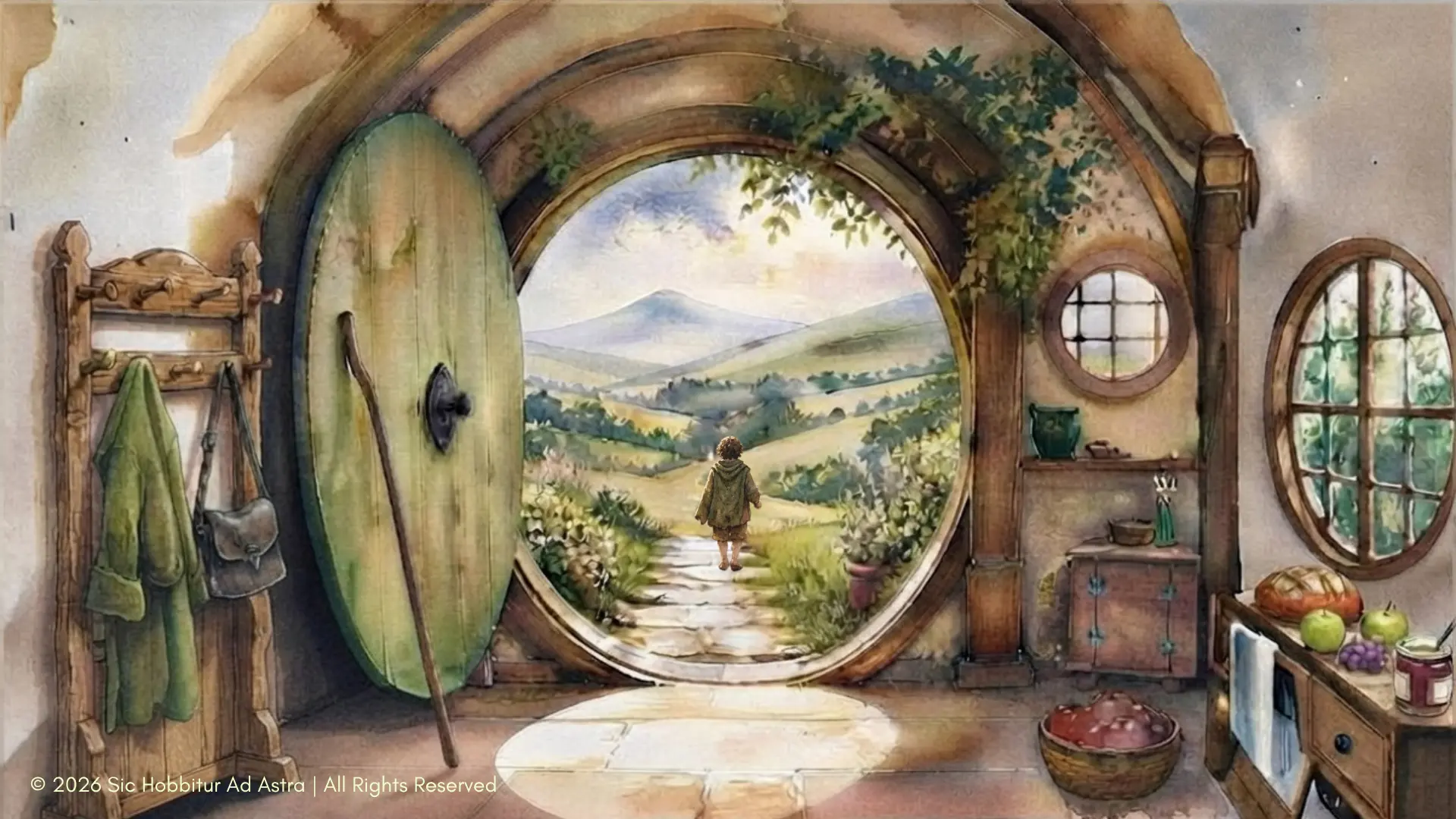
It is never a speech: nobody sits Bilbo down and explains courage to him. What draws it out is, first, a threshold—the door of a comfortable house, left behind. Bilbo is hauled out of his routine before he has fully agreed to any of it, and everything he comes to discover about himself begins on the far side of that door. Middle schoolers know this instinct from the inside, the pull to stay within what is familiar, with the people who are already their friends, doing the things they already do well; and so Bilbo’s first step out is, in miniature, the very step they are being asked to take almost every day.
Then come the trials: Gollum in the dark, the spiders of Mirkwood, the dragon’s hoard. It is worth noticing what these perils are actually for. They are the pressure under which Bilbo’s hidden qualities finally surface, precisely because he has no time to stop and consult the person he had always assumed himself to be. The Bilbo who stands and talks to Smaug is not a new Bilbo at all; he is the one who was there the whole time, finally out of excuses.
Then—and above all—other people. The dwarves are not friends Bilbo would have chosen; they are loud, brusque, nothing like him. And yet it is with them, and for them, that he becomes who he is. This is the deepest of the book’s revelations: we don’t find out what is in us alone. Someone has to be there to need it, to draw it out, and finally to name it—which is precisely what Thorin does with his dying breath. (This thread is the one I follow most closely in my piece on friendship in The Hobbit.)
And then, at last, Bilbo chooses—which is what all the rest was for. Not courage in the abstract, but a particular hobbit deciding, under pressure and without any clear view of the outcome, what to do about a riddle, a ring, a dragon, a stone; and he gets a fair amount of it wrong along the way. Tolkien never makes the moral path obvious, and that is exactly what makes the book worth teaching: students are not told what is right, they watch someone work it out imperfectly and then pay for it. What was hidden in Bilbo does not remain a private quality—it becomes an act, visible and costly.
What This Asks of Us
Here is where the novel stops being about Bilbo.
There is more in you of good than you know. Read one way, it is simply Thorin speaking to a hobbit; read another, it is the wager every teacher makes, silently, at the start of each year. We look at a class and we see what is visible—the grades, the behavior record, the reputation that arrived before the student did, the child who has already decided that they are the one who isn’t good at this—and we bet, because we have to bet, that there is more there than any of that shows, and that the material in front of us is not quite what it appears to be.
The trouble is that this is not something you can teach in a lesson. You can say it—and you should, whenever the moment is right, because the right word at the right time can stay with someone for years. But you cannot assign it. It isn’t a thing a class can be taught on a Tuesday and be tested on by Friday, and no student ever came to believe it about themselves because it was on a slide.
And not everyone is reached the same way. Some students will take it from you directly, in a corridor, in four words after a bad grade. Others won’t hear it from an adult at all—not yet, not from you, not this year. For them it has to arrive from somewhere else, and arrive without being addressed to them.
This is what a book can do that a lesson cannot. So we do what Tolkien does: we don’t announce the thing, we let them watch it happen. We hand them a story in which the least promising creature in the world turns out to have been carrying, all along, exactly what the moment required, and then we let them spend five months in his company. Nobody tells them the lesson; they watch it happen to someone they have come to love, and something quietly rearranges itself.
Why This Book, Then
The vocabulary is rich, the adventure keeps a class reading, the dragon and the riddles and the friendship all earn their place—and I’d defend every one of them, as I’ve done elsewhere in this cluster. But the reason underneath them is simpler, and it is the one that keeps me coming back. We teach The Hobbit because it spends three hundred pages showing a young reader something a teacher can rarely make them believe on request: that what they most need is already in them, waiting for the thing that will ask it of them.
Edoardo Rialti, an Italian scholar of English and American literature, once compared ordinary books to a fast-food sandwich and great ones to a Florentine steak—the difference between what fills you and what feeds you. It is the right test. A book can entertain a class for five months and leave them exactly as it found them; this one hands them back something of their own.
Thorin puts it into words only at the very end, when he has nothing left to gain by saying them: there is more in you of good than you know. It is the truest line in the book, and it is why the book belongs in a classroom—a place where the whole enterprise rests on believing exactly that about children who have not yet given us much reason to. We make that wager every time we open the novel; Bilbo, year after year, quietly suggests it is a reasonable one.
A Ready-Made Resource
If you’d like to bring all of this into the classroom without building it from scratch, I’ve created a complete set of teaching materials for The Hobbit, designed for middle school students—introductory activities, close-reading guides, review, tests, and essay and creative-writing prompts.
Thank you for stopping by!
Happy teaching!
Chiara
Continue Reading
If this way of looking at The Hobbit is useful to you, these companion articles take up the threads it touches—how to open the novel, how to teach it chapter by chapter, and what it has to say about friendship:
- Introducing The Hobbit in Middle School: Runes, Literary Context, and Creative Community — how to open the novel: their own questions, the runes, and the Inklings.
- How to Teach The Hobbit: A Chapter-by-Chapter Guide — a step-by-step method for guiding comprehension, character, and discussion across the whole novel.
- Enhance Middle School ELA Learning with The Hobbit Crosswords — interactive exercises for vocabulary, narrative, and critical thinking.
- Walking Beside Bilbo: Friendship in The Hobbit — what the novel teaches about loyalty, forgiveness, and the companions who make the journey matter.