ARTICLE OVERVIEW
Atticus Finch’s closing argument rewards close study at many levels at once: as a legal argument, a rhetorical text, a moral challenge, and a historical document shaped by the constraints of 1935 Alabama. This article explores each of these dimensions — and shares the classroom approaches I have found most productive for teaching Chapter 20.
If you are looking for ways to teach Atticus Finch’s closing argument, it means you have already recognized what makes it worth the time — and on that, we are completely aligned.
Chapter 20 of To Kill a Mockingbird is one of those texts that teachers return to year after year and find something new in every time. It works as a legal argument, a study in rhetoric, a moral challenge, and a window onto the racial injustice of 1930s America — all at once. Each of these layers can be explored on its own; together, they open questions that stay with students long after the novel is finished.
In this article, I want to share how I read this speech — the questions it opens, the levels at which it can be analyzed — and some of the approaches I have found most productive in the classroom.
1. Why Teaching Atticus Finch’s Closing Argument Rewards Close Study
The closing argument is one of the few moments in the novel where Atticus speaks entirely in his own voice. Throughout the story, we see him through Scout’s eyes — and Scout, for much of the book, does not fully understand what she is witnessing. In Chapter 20, that filter partially lifts. Atticus stands before the jury and says, in plain language, exactly what he believes. The speech is his moral portrait.
This alone makes it worth studying closely. But there is more. The closing argument works simultaneously on several levels, and this is what gives it such extraordinary teaching potential:
As a legal argument, it is precise and economical. Atticus dismantles the prosecution’s case in a few sentences: no medical evidence, two witnesses whose testimony has been contradicted, a defendant whose physical disability makes the alleged crime logically impossible. The logic is airtight — and that is exactly what makes the verdict that follows so devastating.
As a rhetorical text, it repays the kind of attention we usually reserve for poetry. Every word choice, every structural move, every appeal to the jury’s sense of honor and duty is deliberate. Understanding how Atticus speaks turns out to be inseparable from understanding what he is saying — and this is one of the most productive insights to share with students.
As a moral text, it asks the jury — and the reader — to choose between what society expects and what conscience demands. Atticus knows he will lose, and speaks anyway. This is not optimism; it is something rarer and more demanding, and students tend to feel the weight of it even before they can fully articulate why.
As a historical document, it reveals exactly what it is possible and impossible to say in Maycomb, Alabama, in 1935. The constraints of Atticus’s context are as revealing as the argument itself.
And all of this is contained in a few pages. That density is precisely why this moment in the novel rewards — and repays — dedicated time.
2. The Rhetorical Dimension: Why Does He Speak This Way?
When I teach rhetoric through this speech, the question I find most productive is not “which device is this?” but “why does this choice work here, for this audience, at this moment?” That shift — from identification to interpretation — changes everything.
Take the word “gentlemen.” Atticus uses it five times across the speech. He is addressing jurors in a legal proceeding — the obvious word would be “jurors,” a role defined by procedure and institution. “Gentlemen” is something different: a social identity that carries connotations of honor, fairness, and personal moral integrity. By calling them gentlemen repeatedly, Atticus is appealing to their self-image and placing them in a position where they must either live up to the title or silently acknowledge that they cannot. Each repetition renews that pressure.
Or take the concession in lines 18–22 — the moment when Atticus acknowledges that some black men are untrustworthy, immoral, not to be trusted around women. This is the most surprising move in the speech, and also the most sophisticated. It appears to validate the jury’s prejudice, then immediately redirects it: this truth, Atticus says, applies to the human race, not a race. There is not a person in this courtroom who has never lied. What looked like a concession becomes a quiet reversal — the jury’s own assumptions are turned against them.
The devices in this speech are not decorative. They are the argument. And when students begin to see that, the speech stops being a set piece and starts being a genuinely interesting object of study — one that has something to teach about how language works, how persuasion works, and how much depends on reading your audience with precision and care.
3. The Thematic Dimension: What Is He Really Arguing For?
Atticus is arguing for Tom Robinson’s acquittal. But is that all he is arguing for?
I don’t think so. And this is one of the most interesting questions to open in the classroom.
His central claim is that the court of law is the one institution in America where all people genuinely stand on equal ground. A pauper and a Rockefeller, an uneducated man and a college president — before a court, the playing field is level. This makes the court unique. And it makes the jury’s decision uniquely weighty: if they allow prejudice to corrupt their verdict, they are not merely failing Tom Robinson. They are destroying the one institution that gives the American ideal of equality any concrete meaning.
The closing argument is where all the novel’s central threads converge. Atticus is asking the jury to step outside the identity that Maycomb has assigned them and to act instead as individuals with consciences — something their community has never asked of them before, and will not forgive them for attempting.
For teachers who have introduced the novel through a reflection on identity, stereotypes, and shared moral code — as I suggest in this pre-reading article — the closing argument becomes the moment to bring those threads together explicitly. Students who have already grappled with those concepts in the abstract find something deeply satisfying in seeing them embodied, with full force, in Atticus’s words.
Whether the jury can rise to the challenge he sets them is, of course, the question the novel answers with devastating clarity. For a fuller exploration of how this plays out through the novel’s central figures, you might find this article useful: To Kill Two Mockingbirds: Stories of Boo Radley and Tom Robinson.
4. The Historical Dimension: What Can He Not Say?
One of the most productive questions to bring to this text is not “what does Atticus say?” but “what can he not say?”
The closing argument was delivered in a courtroom operating under the Jim Crow laws — the system of racial segregation that governed the American South from the late nineteenth century until the Civil Rights era. Under Jim Crow, black citizens were legally separated from white citizens in schools, hospitals, transport, and public spaces, and were routinely denied access to the ballot, to fair employment, and to equal protection under the law. A black man’s word in a court of law carried almost no weight against a white person’s testimony — not because of any written rule, but because of an unwritten one that everyone in Maycomb understood perfectly.
It is within this framework that Atticus speaks. He cannot accuse the jury of racism directly — to do so would destroy whatever goodwill he has built. He cannot make an openly emotional appeal on Tom Robinson’s behalf without risking a defensive reaction from men who have been told, their entire lives, that certain feelings are simply not to be had. He cannot call the legal system corrupt without undermining the authority of the very institution he is appealing to.
What he can do — and does — is work entirely within the value system of the society he is challenging. He invokes Jefferson, the founding ideal of equality, the dignity of the courts. He uses the language of honor and duty. He frames prejudice not as a moral failing but as “passion” — a word that is softer, more manageable, and less accusatory.
Every choice is shaped by what 1935 Alabama will permit him to say. And recognizing those constraints is, I think, one of the most important things students can take away from this chapter — because it reveals how much courage it takes to speak truthfully even within a system that has already decided the outcome.
In his combination of moral conviction and institutional constraint, Atticus reminds me at times of Jean Valjean in Hugo’s Les Misérables — a man who knows the law will not deliver justice, and who must find a way to act rightly within a system that was not built for him.
5. The Paradox at the Heart of the Speech
Here is the fact that students must eventually sit with.
Atticus delivers what may be the most logically airtight, rhetorically sophisticated, morally serious argument it is possible to make in that courtroom. And the jury convicts Tom Robinson anyway.
This is not a narrative flaw. It is the novel’s most important lesson.
The speech fails not because it is a bad argument, but because the jury was never going to be persuaded by any argument. The verdict was decided before Atticus spoke a word. Prejudice does not yield to reason, because it does not operate through reason. It operates through identity, community, and fear — forces that rhetoric can illuminate but cannot, on its own, overcome.
What is the point of making the right argument if the outcome is already decided?
This is a question that deserves a serious answer, not a reassuring one. The answer the novel offers, I think, is this: Atticus speaks not because he believes the speech will change the verdict. He speaks because someone must. Because the act of speaking truthfully — in public, on the record, with full force of argument — is itself a moral act, regardless of its consequences. The speech is addressed to the jury, but it is also addressed to Scout, to Maycomb, and to history. This is, in the end, part of why I keep coming back to this novel at all — a case I make in full in why To Kill a Mockingbird is a novel worth teaching.
This connects to one of the deepest themes in John Steinbeck’s East of Eden — a novel I have written about elsewhere on this blog, and one I return to often in my teaching. The concept of timshel — “thou mayest” — is Steinbeck’s way of insisting that the human person is never simply the product of circumstances, however powerful those circumstances may be. Cal Trask fears he has inherited his mother’s evil; Lee tells him that this fear, taken seriously, is already the beginning of freedom. Atticus enacts the same truth. He lives in Maycomb, he is subject to its pressures, he knows its limits — and he chooses, anyway, to act with integrity. The choice does not save Tom Robinson. But it is still a choice, freely made, and it matters.
6. Atticus Finch: A Figure Worth Encountering
I want to say something that goes beyond the pedagogical framework of this article — because I think it matters for how we bring this text into the classroom.
Atticus Finch is one of those rare literary figures who functions not just as a character to be analyzed, but as a model to be encountered. Students do not merely study him; they are affected by him. There is something in his combination of moral courage and quiet restraint — the fact that he does not perform his integrity, but simply lives it — that tends to stay with young readers long after the novel is finished. I have written about this in more depth in a fuller character study of Atticus as an educator.
What the closing argument adds to our understanding of Atticus is this: it shows us the full cost of his integrity. We see him in the clearest light of his situation — knowing he will lose, choosing to speak anyway, asking twelve men to be better than they are. It is not a triumphant moment. It is something quieter and more lasting than triumph.
7. Teaching Atticus Finch’s Closing Argument: What I Have Found Works
Here are a few approaches I have found productive when teaching this chapter — tried over several years, and offered as a starting point rather than a model.
- Begin with an uninterrupted reading. I ask students to read the speech all the way through without stopping, then write one sentence: what does this speech make you feel, before you know how to explain it? These first impressions are worth keeping — I return to them at the end of the unit, and the distance between what students wrote then and what they can say afterward is often the clearest measure of how much has happened.
- Ask why, not what. When I ask students to identify rhetorical devices, I get lists. When I ask “why does Atticus speak this way — why this word, why now, for these twelve men?” I get something much more interesting. Making the shift from identification to interpretation explicit from the start changes the quality of the work.
- Bring in the historical context early. The Jim Crow framework is not background information — it is the key to understanding why every word in the speech is calibrated as it is. Students who understand what Atticus cannot say understand the speech at a completely different depth.
- Make the connection to the pre-reading concepts explicit. The speech is where identity, stereotypes, and shared moral code all come into focus at once. Students who have already explored those ideas tend to find the analysis more meaningful — and more personally relevant.
- Don’t resolve the paradox too quickly. The conviction that follows this extraordinary speech is the most important moment to sit with. Some of the most honest conversations I have had in the classroom have started from the discomfort of asking what it means when the right argument is simply not enough.
A Ready-to-Use Resource
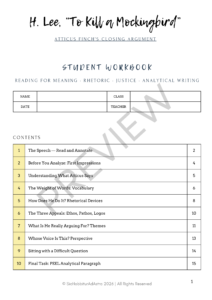
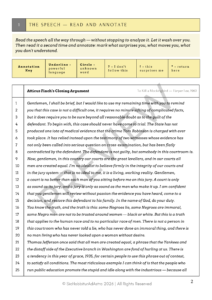
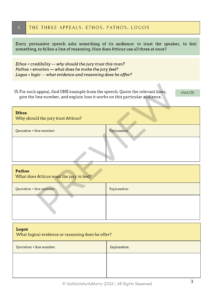
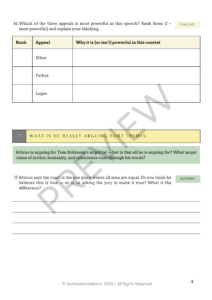
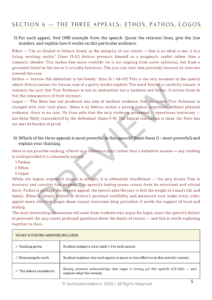
If you would like a structured, print-ready resource to guide your students through this analysis, I have created a Student Workbook + Teacher’s Guide specifically dedicated to Chapter 20.
The workbook guides students through ten graduated sections — from first impressions and close reading through rhetorical analysis, theme exploration, historical context, and personal reflection — before arriving at a structured PEEL analytical paragraph as a final task. The Teacher’s Guide includes model answers, assessment criteria for every open question, and a full pedagogical framework.
The resource is available on TPT: Atticus Finch’s Closing Argument — Student Workbook + Teacher’s Guide | Grades 8–10. Here is a look at what the resource looks like:
Thank you for stopping by!
I hope this guide is useful as you prepare to bring Chapter 20 into your classroom — and I hope your students find in Atticus’s words something that stays with them.
Happy teaching,
Chiara