ARTICLE OVERVIEW
Teaching a 300-page novel to middle schoolers without either rushing it or drowning in prep is a real challenge. Over years of teaching The Hobbit, I’ve refined a step-by-step method that keeps the reading slow and thoughtful while staying manageable for the teacher: a chapter a week, structured worksheets for comprehension and analysis, homework that lets students revisit the story, discussion at the heart of each lesson, and a final assessment. This article walks through the whole framework, with concrete examples and creative activities—everything you need to turn The Hobbit into a rich, term-long close-reading journey.
Thinking about diving into The Hobbit with your middle school students? Excellent choice! This novel is perfect for young readers eager for adventure, friendship, and personal growth. It’s a treasure trove of ideas and themes to explore with your students, one by one (I go into this in depth in my article about the educational value of The Hobbit in Middle School, which explains why this book is truly worth including in your curriculum).
At the same time, the bigger the work, the greater the challenge for teachers who want to present it without simplifying or diminishing it. And if, like me, you don’t always have a lot of free time to prepare lessons, the challenge can feel even more daunting.
I was exactly in that situation years ago when I first started teaching this novel. I spent hours shaping lessons so that my students could experience the story as fully as possible. Here, I want to share a step-by-step method that, refined over time, has proven to be the most effective approach for close reading and textual analysis of this wonderful work.
It’s a structured approach—one that combines reading, reflection, and creative activities—comprehensive and enriching, complete with practical examples and classroom strategies, making the experience both meaningful and manageable for middle school students.
1. FIRST STEP – INTRODUCING THE READING: Setting the Stage
2. SECOND STEP – ANALYSIS WORKSHEETS: Guiding Deeper Thinking
3. THIRD STEP – HOMEWORK AND NOTEBOOK ORGANIZATION: Building Independent Habits
4. FOURTH STEP – CLASSROOM DISCUSSIONS AND FEEDBACK: Sharing Perspectives
5. FIFTH STEP – FINAL ASSESSMENT: Reflecting and Synthesizing
6. Bonus Activities: Making Learning Fun
1. First Step – Introducing the Reading: Setting the Stage
The Hobbit deserves a slow, thoughtful reading, giving students time to savor the story and absorb its themes. I always begin with an engaging and unusual introduction to the novel (in this guide to introducing The Hobbit in middle school, I go into detail about the strategy I’ve used for years to kick off the reading: check it out!).
After the introduction, I usually structure the lessons as follows:
- Read one chapter per week. With 19 chapters, this typically takes 4–5 months.
- Dedicate two hours weekly to the book: the first hour for reviewing homework, discussing the previous chapter, and quizzes; the second hour for reading the new chapter together.
- Use structured worksheets to guide comprehension, analysis, and reflection. These tools help students ask the right questions and find key details, both in class and at home.
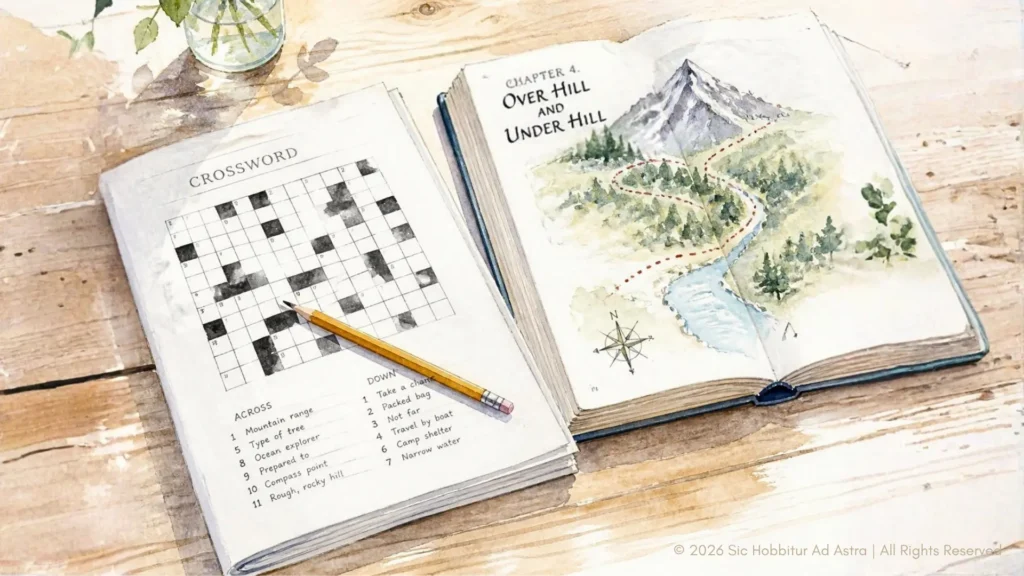
- Mix in creative activities like crosswords for vocabulary reinforcement or writing letters to characters to deepen engagement.
- Wrap up with a final test that evaluates comprehension and reflection on themes.
This structure helps students navigate the story while giving teachers a clear roadmap to follow.
Now, let’s get into the details!
Check out the example worksheet for Chapter 1 that I’ve attached. You can download it here:
2. Second Step – Analysis Worksheets: Guiding Deeper Thinking
The Hobbit is rich in meaning and offers various levels of interpretation. To make text analysis accessible, I divide the worksheets into four complementary sections:
- COMPREHENSION: Simple questions about the plot that I read aloud before starting. Students keep this handy during reading to stay focused and enhance comprehension skills.
- VOCABULARY: Focuses on specific terms and literary devices. Students complete this at home using a dictionary if needed.
- INTERPRETATION: Encourages deeper reflection, helping students identify cause-effect relationships, character psychology, and more. Assigned as homework for the next lesson.
- ENGAGEMENT: Personal reflection exercises that connect themes from the book to students’ experiences. This is assigned for the next lesson and helps students internalize their learning.
All these worksheets are designed to build skills gradually, supporting comprehension, analysis, and discussion. The full set (one for each chapter, with solutions) is available in my Novel Study Bundle.
3. Third Step – Homework and Notebook Organization: Building Independent Habits
Homework is more than a task—it’s an opportunity for students to revisit each chapter at their own pace, making meaning of the story and reflecting on characters and themes.
I recommend keeping a dedicated notebook for The Hobbit: each chapter’s questions, reflections, and creative responses are collected here. This organized approach ensures continuity, helping students prepare for discussions and the final test.
4. Fourth Step – Classroom Discussions and Feedback: Sharing Perspectives
Discussion is the heart of teaching literature. I usually dedicate part of the lesson to reviewing homework, inviting students to share their answers and interpretations.
I encourage one or two students to lead the discussion, while the rest follow along using the worksheets as a guide. The focus is on meaningful dialogue, not formal interrogation: students feel safe, motivated, and confident to express their perspectives.
This is often the most rewarding part of the lesson—where students not only articulate their thoughts but also connect The Hobbit to their own experiences, exploring themes like courage, friendship, and the choices that shape who they are. (Friendship in particular runs deeper in this novel than students first expect—I follow that thread in what The Hobbit teaches about friendship.)
5. Fifth Step – Final Assessment: Reflecting and Synthesizing
The final test combines comprehension and reflection: multiple-choice, short answers, and essay prompts that ask students to think critically about characters, plot, and themes.
By this point, students have internalized the story, linked it to real-life experiences, and developed analytical skills that go beyond the novel itself. A detailed version of the final test is included in my complete Mega Bundle.
Bonus Activities: Making Learning Fun
To make things even more engaging, I love incorporating fun activities. Creative exercises make the story come alive! My favorites include:
- Crossword puzzles for vocabulary practice.
- Writing letters to characters to explore perspective and empathy.
- Character reviews where students rank, debate, or defend character decisions.
Variety keeps students engaged and reinforces comprehension, while also nurturing creativity.
Bringing It All Together
Using this method, students not only read The Hobbit—they analyze it, reflect on it, and relate it to their own lives. Middle schoolers explore friendship, courage, resilience, and curiosity alongside Bilbo, Thorin, Gandalf, and the dwarves.
Ready to get started? My complete Mega Bundle includes:
- Creative activities and final assessments
- 19 chapter worksheets with solutions
- Structured homework and discussion prompts
(The Mega Bundle includes everything in the Novel Study Bundle mentioned above, plus introductory activities, review materials, tests, and essay prompts—so there’s no need to buy both.)
How do you work with your students on texts? Share your thoughts in the comments—I’d love to hear from you!
Still unsure if this novel is right for you? Check out my article on why it’s a great choice for students!
Thank you for stopping by!
Happy teaching!
Chiara