

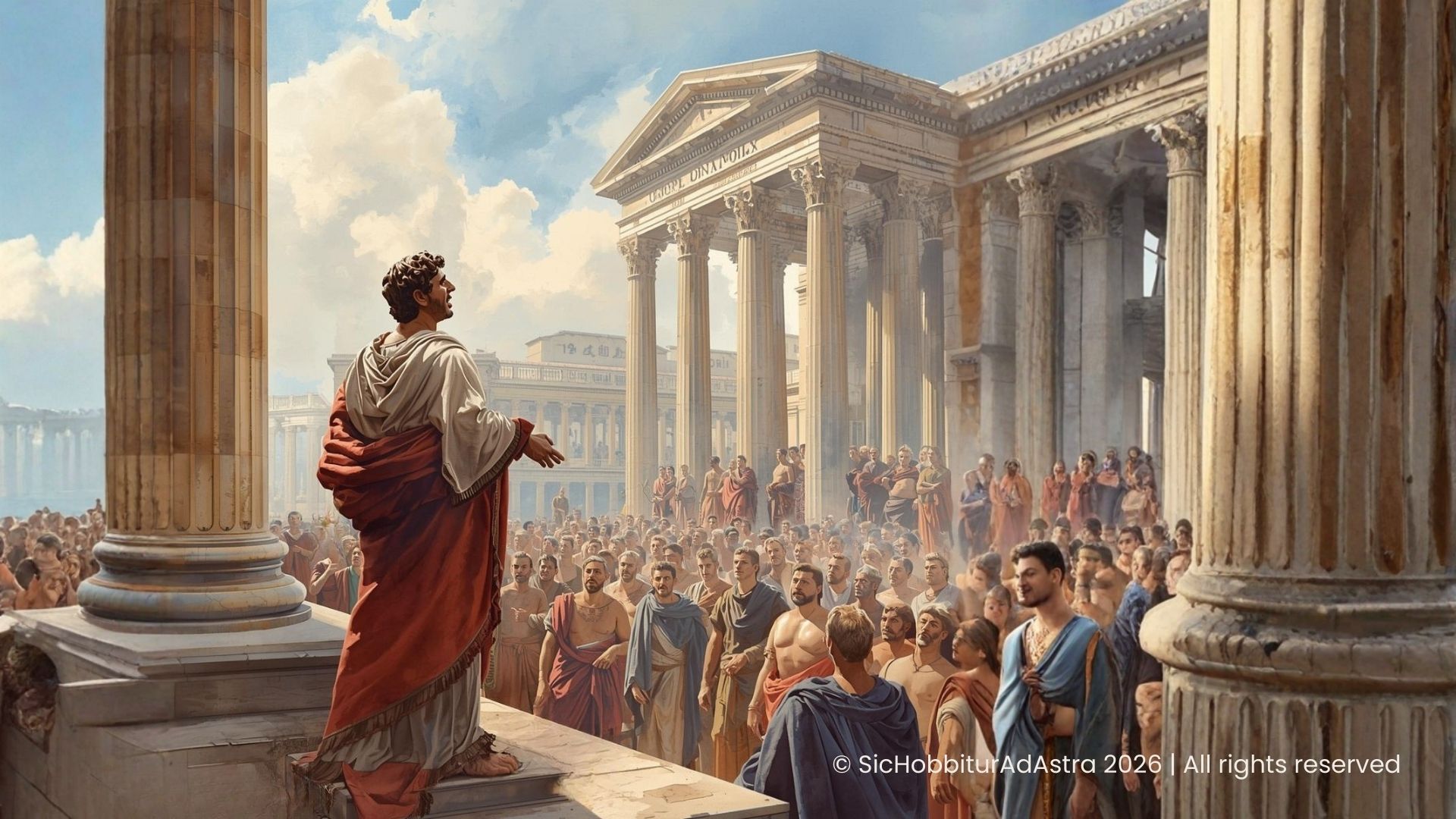
Do you have students who are deeply passionate about history—eager for Rome, politics, and great historical figures—yet far less enthusiastic about literature? Or perhaps students with a remarkable curiosity and a clear gift for the humanities, yet who simply refuse to read? I have had a few over the years—students whose attention to detail, insight, and capacity for reasoning made it obvious they could excel in humanistic studies, and yet who had no interest in picking up a book. Still, these same students are captivated by stories, by events, by people—especially people who shape history.
Sometimes, all it takes is the right book to meet them where their curiosity already lives. Imperium, by Robert Harris (Hutchinson, 2006), is exactly that kind of reading. For the first years of high school, it offers a rare balance: historically grounded, intellectually serious, and yet vividly readable. Above all, it opens an unforgettable window into the life of one of antiquity’s most compelling political minds: Marcus Tullius Cicero. Imperium is also the first volume of a trilogy—followed by Conspirata and Dictator—allowing students to continue Cicero’s political journey and see his story unfold in even greater depth.
The Story of Cicero’s Rise
Imperium traces Cicero’s journey from a young, physically fragile lawyer with modest means to the threshold of the Roman consulship—the highest office of the Republic. The story is built around pivotal moments: his disciplined study of Greek rhetoric, the audacious prosecution of the corrupt governor Verres, the delicate navigation of alliances with powerful figures like Pompey, and the confrontation with Catiline, where ambition, fear, and revenge converge in public life.
Far from being a simple biography, the novel portrays the drama of political becoming: the careful construction of authority through strategy, words, endurance, and risk. Students witness a mind and destiny in the making, rather than a pre-formed hero.
Politics as Human Drama
One of the novel’s most striking passages captures Cicero’s view when politics is dismissed as dull:
“Politics? Boring? Politics is history on the wing! What other sphere of human activity calls forth all that is most noble in men’s souls, and all that is most base? Or has such excitement? Or more vividly exposes our strengths and weaknesses? Boring? You might as well say that life itself is boring!”
This is where Imperium excels as historical fiction about Cicero: Rome becomes more than a collection of facts; it becomes a stage where human nature is vividly exposed—ambition beside courage, vanity beside sacrifice, calculation beside idealism. For students drawn to classical culture, this transformation is crucial: history becomes something they can recognize and feel, not merely memorize.
The Moral Cost of Power
Imperium does not romanticize political life. Its deepest thematic insight comes in a line that captures the tension at the heart of the Republic:
“The trouble is thinking that politics is a struggle for the triumph of justice. It is not. Politics is a profession.”
This prompts students to grapple with profound questions: Can justice survive in systems built on competition and compromise? Can political success coexist with moral integrity? Are leaders truly free to shape history, or are they shaped by circumstance and necessity? Historical fiction becomes a lens for understanding the moral complexities of leadership in any era.
A Different Kind of Political Hero
Cicero is not a conqueror, nor does he command armies. His strength lies in discipline, rhetoric, and endurance. Harris captures this vividly:
“No one can really claim to know politics properly until he has stayed up all night writing a speech for delivery the following day. While the world sleeps, the orator paces by lamplight, wondering what madness ever brought him to this occupation in the first place. Arguments are prepared and discarded. The exhausted mind ceases to have any coherent grip upon the purpose of the enterprise, so that often–usually an hour or two after midnight–there comes a point where failing to turn up, feigning illness, and hiding at home seem the only realistic options. And then, somehow, just as a panic and humiliation beckon, the parts cohere, and there it is: a speech. A second-rate orator now retires gratefully to bed. A Cicero stays up and commits it to memory.”
For students, this is revelatory. History is not shaped solely by generals and battles—it is also crafted by thinkers, speakers, and interpreters of law. Such realizations quietly broaden their understanding of what leadership and influence can truly mean.
Why This Reading Matters in Early High School
At this stage, the right book can ignite a lasting intellectual fascination. Imperium succeeds because it unites elements that rarely coexist: narrative momentum that sustains young readers’ attention, historical seriousness that respects the complexity of Rome, psychological depth that invites interpretation rather than passive admiration, and clear, elegant prose that makes demanding themes accessible. It is, simply, a book that can transform historical curiosity into literary engagement.
My students, in particular, have loved this reading for the way it brings Cicero to life—offering a vivid, concrete, and fascinating portrait of a man who might otherwise have seemed remote, antique, or “a name from a dusty textbook” (thank you, Matt, for this perfect description!).
A Novel That Opens the Door to Rome
Recommending Imperium is a deeply felt gesture toward our students. Some are already drawn to great political figures, historical turning points, and the austere fascination of Roman civilization—they are simply waiting for a book that can meet them there.
Dear colleague, hand your students Imperium and let them step into the Forum, feel the pulse of the Republic, and experience the tension of a young Cicero as he navigates risk, ambition, and justice. They may well find themselves thinking, feeling, and imagining Rome as if they were walking its streets—a kind of engagement that lasts far beyond the last page.
Happy reading!
Chiara


